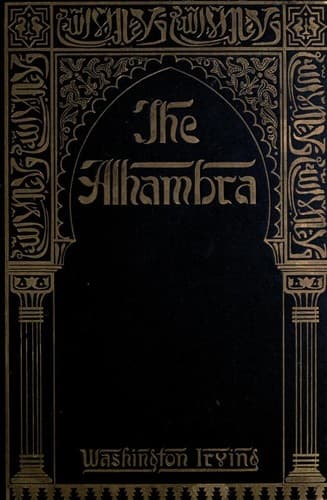
Verhalen over het gebouwencomplex in Granada, dat eigendom was van de laatste islamitische vorsten in Spanje.
See to the south at the foot of those mountains a line of arid hills,
down which a long train of mules is slowly moving. Here was the closing
scene of Moslem domination. From the summit of one of those hills the
unfortunate Boabdil cast back his last look upon Granada, and gave vent
to the agony of his soul. It is the spot famous in song and story, “The
last sigh of the Moor.”
Further this way these arid hills slope down into the luxurious Vega,
from which he had just emerged: a blooming wilderness of grove and
garden, and teeming orchard, with the Xenil winding through it in silver
links, and feeding innumerable rills; which, conducted through ancient
Moorish channels, maintain the landscape in perpetual verdure. Here were
the beloved bowers and gardens, and rural pavilions, for which the
unfortunate Moors fought with such desperate valor. The very hovels and
rude granges; now inhabited by boors, show, by the remains of arabesques
and other tasteful decoration, that they were elegant residences in the
days of the Moslems. Behold, in the very centre of this eventful plain,
a place which in a manner links the history of the Old World with that
of the New. Yon line of walls and towers gleaming in the morning sun, is
the city of Santa Fe, built by the Catholic sovereigns during the siege
of Granada, after a conflagration had destroyed their camp. It was to
these walls Columbus was called back by the heroic queen, and within
them the treaty was concluded which led to the discovery of the Western
World. Behind yon promontory to the west is the bridge of Pinos,
renowned for many a bloody fight between Moors and Christians. At this
bridge the messenger overtook Columbus when, despairing of success with
the Spanish sovereigns, he was departing to carry his project of
discovery to the court of France.
Above the bridge a range of mountains bounds the Vega to the west,--the
ancient barrier between Granada and the Christian territories. Among
their heights you may still discern warrior towns; their gray walls and
battlements seeming of a piece with the rocks on which they are built.
Here and there a solitary atalaya, or watchtower, perched on a mountain
peak, looks down as it were from the sky into the valley on either side.
How often have these atalayas given notice, by fire at night or smoke by
day, of an approaching foe! It was down a cragged defile of these
mountains, called the Pass of Lope, that the Christian armies descended
into the Vega. Round the base of yon gray and naked mountain (the
mountain of Elvira), stretching its bold rocky promontory into the bosom
of the plain, the invading squadrons would come bursting into view, with
flaunting banners and clangor of drum and trumpet.
Public-domain text, read in full here on John Shaqi.
Reviews
Reviews
No reviews yet
Be the first to share your thoughts on this work.
Elsewhere in the archive
Join the Discussion
Join the discussion
Sign in to leave a comment or review.
Sign InorCreate an account