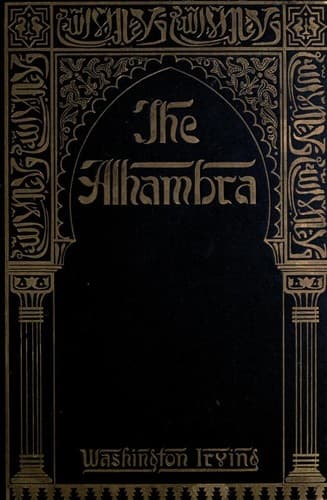
Verhalen over het gebouwencomplex in Granada, dat eigendom was van de laatste islamitische vorsten in Spanje.
Thus for several years the country was torn by internal strife and
desolated by foreign inroads, so that scarce a field but was stained
with blood. Aben Osmyn was brave, and often signalized himself in arms;
but he was cruel and despotic, and ruled with an iron hand. He offended
the nobles by his caprices, and the populace by his tyranny, while his
rival cousin conciliated all hearts of his benignity. Hence there were
continual desertions from Granada to the fortified camp at Montefrio,
and the party of Aben Ismael was constantly gaining strength. At length
the king of Castile, having made peace with the kings of Aragon and
Navarre, was enabled to send a choice body of troops to the assistance
of Aben Ismael. The latter now left his trenches in Montefrio, and took
the field. The combined forces marched upon Granada. Aben Osmyn sallied
forth to the encounter. A bloody battle ensued, in which both of the
rival cousins fought with heroic valor. Aben Osmyn was defeated and
driven back to his gates. He summoned the inhabitants to arms, but few
answered to his call; his cruelty had alienated all hearts. Seeing his
fortunes at an end, he determined to close his career by a signal act of
vengeance. Shutting himself up in the Alhambra, he summoned thither a
number of the principal cavaliers whom he suspected of disloyalty. As
they entered, they were one by one put to death. This is supposed by
some to be the massacre which gave its fatal name to the Hall of the
Abencerrages. Having perpetrated this atrocious act of vengeance, and
hearing by the shouts of the populace that Aben Ismael was already
proclaimed king in the city, he escaped with his satellites by the Cerro
del Sol and the valley of the Darro to the Alpuxarra Mountains; where he
and his followers led a kind of robber life, laying villages and roads
under contribution.
Aben Ismael II., who thus attained the throne in 1454, secured the
friendship of King Juan II. by acts of homage and magnificent presents.
He gave liberal rewards to those who had been faithful to him, and
consoled the families of those who had fallen in his cause. During his
reign, the Abencerrages were again among the most favored of the
brilliant chivalry that graced his court. Aben Ismael, however, was not
of a warlike spirit; his reign was distinguished rather by works of
public utility, the ruins of some of which are still to be seen on the
Cerro del Sol.
Public-domain text, read in full here on John Shaqi.
Reviews
Reviews
No reviews yet
Be the first to share your thoughts on this work.
Elsewhere in the archive
Join the Discussion
Join the discussion
Sign in to leave a comment or review.
Sign InorCreate an account