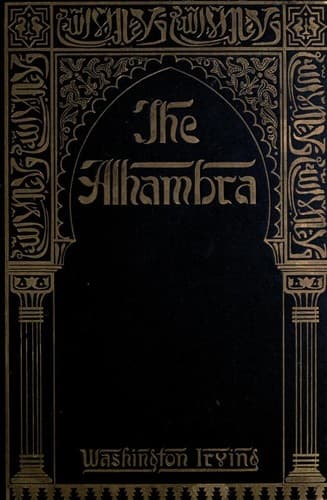
Verhalen over het gebouwencomplex in Granada, dat eigendom was van de laatste islamitische vorsten in Spanje.
In this historical outline, I trust I have shown enough to put the fable
concerning Boabdil and the Abencerrages in a true light. The story of
the accusation of his queen, and his cruelty to his sister, are equally
void of foundation. In his domestic relations he appears to have been
kind and affectionate. History gives him but one wife, Morayma, the
daughter of the veteran alcayde of Loxa, old Aliatar, famous in song and
story for his exploits in border warfare; and who fell in that
disastrous foray into the Christian lands in which Boabdil was taken
prisoner. Morayma was true to Boabdil throughout all his vicissitudes.
When he was dethroned by the Castilian monarchs, she retired with him to
the petty domain allotted him in the valleys of the Alpuxarras. It was
only when (dispossessed of this by the jealous precautions and subtle
chicanery of Ferdinand, and elbowed, as it were, out of his native land)
he was preparing to embark for Africa, that her health and spirits,
exhausted by anxiety and long suffering, gave way, and she fell into a
lingering illness aggravated by corroding melancholy. Boabdil was
constant and affectionate to her to the last; the sailing of the ships
was delayed for several weeks, to the great annoyance of the suspicious
Ferdinand. At length Morayma sank into the grave, evidently the victim
of a broken heart, and the event was reported to Ferdinand by his agent
as one propitious to his purposes, removing the only obstacle to the
embarkation of Boabdil.[12]
MEMENTOS OF BOABDIL
While my mind was still warm with the subject of the unfortunate
Boabdil, I set forth to trace the mementos of him still existing in this
scene of his sovereignty and misfortunes. In the Tower of Comares,
immediately under the Hall of Ambassadors, are two vaulted rooms,
separated by a narrow passage; these are said to have been the prisons
of himself and his mother, the virtuous Ayxa la Horra; indeed, no other
part of the tower would have served for the purpose. The external walls
of these chambers are of prodigious thickness, pierced with small
windows secured by iron bars. A narrow stone gallery, with a low
parapet, extends along three sides of the tower just below the windows,
but at a considerable height from the ground. From this gallery, it is
presumed, the queen lowered her son with the scarfs of herself and her
female attendants during the darkness of the night to the hillside,
where some of his faithful adherents waited with fleet steeds to bear
him to the mountains.
Between three and four hundred years have elapsed, yet this scene of the
drama remains almost unchanged. As I paced the gallery, my imagination
pictured the anxious queen leaning over the parapet, listening, with the
throbbings of a mother’s heart, to the last echoes of the horses’ hoofs
as her son scoured along the narrow valley of the Darro.
Public-domain text, read in full here on John Shaqi.
Reviews
Reviews
No reviews yet
Be the first to share your thoughts on this work.
Elsewhere in the archive
Join the Discussion
Join the discussion
Sign in to leave a comment or review.
Sign InorCreate an account