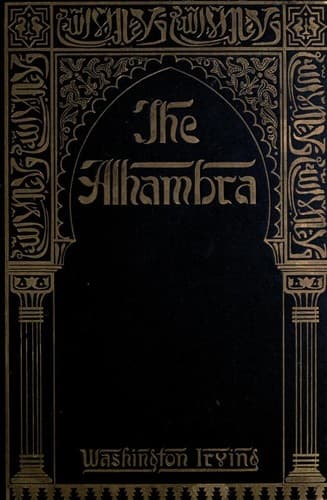
Verhalen over het gebouwencomplex in Granada, dat eigendom was van de laatste islamitische vorsten in Spanje.
Mounting my horse, I followed up the route of the Moslem monarch from
this place of his exit. Crossing the hill of Los Martyros, and keeping
along the garden-wall of a convent bearing the same name, I descended a
rugged ravine beset by thickets of aloes and Indian figs, and lined with
caves and hovels swarming with gypsies. The descent was so steep and
broken that I was fain to alight and lead my horse. By this _via
dolorosa_ poor Boabdil took his sad departure to avoid passing through
the city; partly, perhaps, through unwillingness that its inhabitants
should behold his humiliation; but chiefly, in all probability, lest it
might cause some popular agitation. For the last reason, undoubtedly,
the detachment sent to take possession of the fortress ascended by the
same route.
Emerging from this rough ravine, so full of melancholy associations, and
passing by the _puerta de los molinos_ (the gate of the mills), I issued
forth upon the public promenade called the Prado; and pursuing the
course of the Xenil, arrived at a small chapel, once a mosque, now the
Hermitage of San Sebastian. Here, according to tradition, Boabdil
surrendered the keys of Granada to King Ferdinand. I rode slowly thence
across the Vega to a village where the family and household of the
unhappy king awaited him, for he had sent them forward on the preceding
night from the Alhambra, that his mother and wife might not participate
in his personal humiliation, or be exposed to the gaze of the
conquerors. Following on in the route of the melancholy band of royal
exiles, I arrived at the foot of a chain of barren and dreary heights,
forming the skirt of the Alpuxarra Mountains. From the summit of one of
these the unfortunate Boabdil took his last look at Granada; it bears a
name expressive of his sorrows, _La Cuesta de las Lagrimas_ (the hill of
tears). Beyond it, a sandy road winds across a rugged cheerless waste,
doubly dismal to the unhappy monarch, as it led to exile.
I spurred my horse to the summit of a rock, where Boabdil uttered his
last sorrowful exclamation, as he turned his eyes from taking their
farewell gaze: it is still denominated _el ultimo suspiro del Moro_ (the
last sigh of the Moor). Who can wonder at his anguish at being expelled
from such a kingdom and such an abode? With the Alhambra he seemed to be
yielding up all the honors of his line, and all the glories and delights
of life.
It was here, too, that his affliction was embittered by the reproach of
his mother, Ayxa, who had so often assisted him in times of peril, and
had vainly sought to instil into him her own resolute spirit. “You do
well,” said she, “to weep as a woman over what you could not defend as a
man”; a speech savoring more of the pride of the princess than the
tenderness of the mother.
Public-domain text, read in full here on John Shaqi.
Reviews
Reviews
No reviews yet
Be the first to share your thoughts on this work.
Elsewhere in the archive
Join the Discussion
Join the discussion
Sign in to leave a comment or review.
Sign InorCreate an account