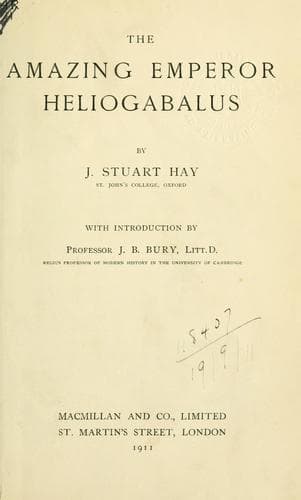
“I would never have written the life of Antoninus Impurissimus,” said
Lampridius, “were it not that he had predecessors.” Even in Latin
the task was difficult. In English it would be impossible, at least
Lampridius’ life. There are subjects that permit of a hint, particularly
if it be masked to the teeth, but there are others that no art can drape,
not even the free use of Latin substantives. Our task therefore is to
deal, rather with their sins of omission, than with the biographers’
offences against all canons of good taste in recording the inexpressible.
In his work on the Caesars, Suetonius displayed the eccentricities
simply, without adding any descriptive placards; therein lay Suetonius’
advantage; he was able to describe; nowadays a writer may not, at least
not the character we possess of Elagabalus. It is not that he was
depraved, for all his house was; it is, that, like many moderns, he made
depravity a pursuit, and the aegis of the purple has carried the stories
beyond the limits of the imaginable, let alone beyond the limits of the
real. Were we to accept unexamined, the testimony of his traducers of
the Christian era, we would gather that “at the feet of that painted boy
Elephantis and Parrhasius could have sat and learned a lesson,” that
“apart from that phase of his sovereignty, he was a little Sardanapalus,
an Asiatic Mignon, who found himself great.” Of course it would have
been curious to see him in that wonderful palace, clothed like a Persian
queen, insisting that he should be addressed as Imperatrix, and quite
living up to the title. It would not only have been interesting, it would
have given one an insight into how much Rome saw and how much she could
stand.
Public-domain text, read in full here on John Shaqi.
Reviews
Reviews
No reviews yet
Be the first to share your thoughts on this work.
Elsewhere in the archive
Join the Discussion
Join the discussion
Sign in to leave a comment or review.
Sign InorCreate an account