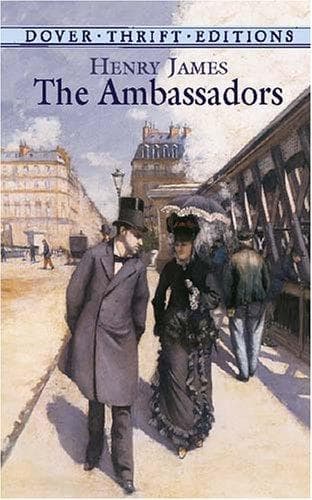
Americans -- France -- Fiction; Man-woman relationships -- Fiction; Paris (France) -- Fiction; Psychological fiction; Young men -- Fiction
“Are you capable of the very great kindness of going to relieve
Newsome, for a few minutes, of the rather crushing responsibility of
Madame Gloriani, while I say a word, if he’ll allow me, to Mr.
Strether, of whom I’ve a question to ask? Our host ought to talk a bit
to those other ladies, and I’ll come back in a minute to your rescue.”
She made this proposal to Miss Barrace as if her consciousness of a
special duty had just flickered-up, but that lady’s recognition of
Strether’s little start at it—as at a betrayal on the speaker’s part of
a domesticated state—was as mute as his own comment; and after an
instant, when their fellow guest had good-naturedly left them, he had
been given something else to think of. “Why has Maria so suddenly gone?
Do you know?” That was the question Madame de Vionnet had brought with
her.
“I’m afraid I’ve no reason to give you but the simple reason I’ve had
from her in a note—the sudden obligation to join in the south a sick
friend who has got worse.”
“Ah then she has been writing you?”
“Not since she went—I had only a brief explanatory word before she
started. I went to see her,” Strether explained—“it was the day after I
called on you—but she was already on her way, and her concierge told me
that in case of my coming I was to be informed she had written to me. I
found her note when I got home.”
Madame de Vionnet listened with interest and with her eyes on
Strether’s face; then her delicately decorated head had a small
melancholy motion. “She didn’t write to _me_. I went to see her,” she
added, “almost immediately after I had seen you, and as I assured her I
would do when I met her at Gloriani’s. She hadn’t then told me she was
to be absent, and I felt at her door as if I understood. She’s
absent—with all respect to her sick friend, though I know indeed she
has plenty—so that I may not see her. She doesn’t want to meet me
again. Well,” she continued with a beautiful conscious mildness, “I
liked and admired her beyond every one in the old time, and she knew
it—perhaps that’s precisely what has made her go—and I dare say I
haven’t lost her for ever.” Strether still said nothing; he had a
horror, as he now thought of himself, of being in question between
women—was in fact already quite enough on his way to that, and there
was moreover, as it came to him, perceptibly, something behind these
allusions and professions that, should he take it in, would square but
ill with his present resolve to simplify. It was as if, for him, all
the same, her softness and sadness were sincere. He felt that not less
when she soon went on: “I’m extremely glad of her happiness.” But it
also left him mute—sharp and fine though the imputation it conveyed.
What it conveyed was that _he_ was Maria Gostrey’s happiness, and for
the least little instant he had the impulse to challenge the thought.
He could have done so however only by saying “What then do you suppose
to be between us?” and he was wonderfully glad a moment later not to
Public-domain text, read in full here on John Shaqi.
Reviews
Reviews
No reviews yet
Be the first to share your thoughts on this work.
Elsewhere in the archive
Join the Discussion
Join the discussion
Sign in to leave a comment or review.
Sign InorCreate an account