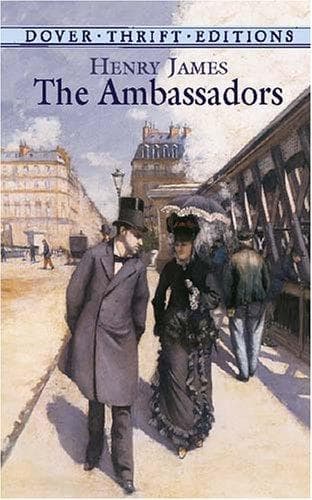
Americans -- France -- Fiction; Man-woman relationships -- Fiction; Paris (France) -- Fiction; Psychological fiction; Young men -- Fiction
Thus it was at all events that, one morning some dozen days after the
dinner in the Boulevard Malesherbes at which Madame de Vionnet had been
present with her daughter, he was called upon to play his part in an
encounter that deeply stirred his imagination. He had the habit, in
these contemplations, of watching a fellow visitant, here and there,
from a respectable distance, remarking some note of behaviour, of
penitence, of prostration, of the absolved, relieved state; this was
the manner in which his vague tenderness took its course, the degree of
demonstration to which it naturally had to confine itself. It hadn’t
indeed so felt its responsibility as when on this occasion he suddenly
measured the suggestive effect of a lady whose supreme stillness, in
the shade of one of the chapels, he had two or three times noticed as
he made, and made once more, his slow circuit. She wasn’t prostrate—not
in any degree bowed, but she was strangely fixed, and her prolonged
immobility showed her, while he passed and paused, as wholly given up
to the need, whatever it was, that had brought her there. She only sat
and gazed before her, as he himself often sat; but she had placed
herself, as he never did, within the focus of the shrine, and she had
lost herself, he could easily see, as he would only have liked to do.
She was not a wandering alien, keeping back more than she gave, but one
of the familiar, the intimate, the fortunate, for whom these dealings
had a method and a meaning. She reminded our friend—since it was the
way of nine tenths of his current impressions to act as recalls of
things imagined—of some fine firm concentrated heroine of an old story,
something he had heard, read, something that, had he had a hand for
drama, he might himself have written, renewing her courage, renewing
her clearness, in splendidly-protected meditation. Her back, as she
sat, was turned to him, but his impression absolutely required that she
should be young and interesting, and she carried her head moreover,
even in the sacred shade, with a discernible faith in herself, a kind
of implied conviction of consistency, security, impunity. But what had
such a woman come for if she hadn’t come to pray? Strether’s reading of
such matters was, it must be owned, confused; but he wondered if her
attitude were some congruous fruit of absolution, of “indulgence.” He
knew but dimly what indulgence, in such a place, might mean; yet he
had, as with a soft sweep, a vision of how it might indeed add to the
zest of active rites. All this was a good deal to have been denoted by
a mere lurking figure who was nothing to him; but, the last thing
before leaving the church, he had the surprise of a still deeper
quickening.
Public-domain text, read in full here on John Shaqi.
Reviews
Reviews
No reviews yet
Be the first to share your thoughts on this work.
Elsewhere in the archive
Join the Discussion
Join the discussion
Sign in to leave a comment or review.
Sign InorCreate an account