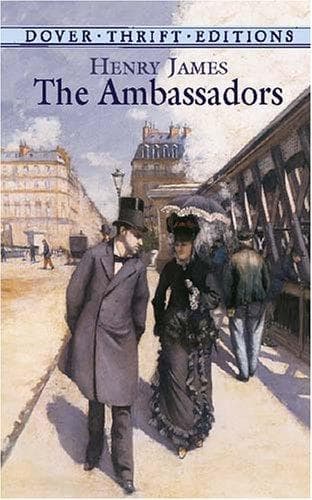
Americans -- France -- Fiction; Man-woman relationships -- Fiction; Paris (France) -- Fiction; Psychological fiction; Young men -- Fiction
“Ah, let me explain,” she smiled, “that I don’t go about with him in
public; I never have such chances—not having them otherwise—and it’s
just the sort of thing that, as a quiet creature living in my hole, I
adore.” It was more than kind of him to have thought of it—though,
frankly, if he asked whether she had time she hadn’t a single minute.
That however made no difference—she’d throw everything over. Every duty
at home, domestic, maternal, social, awaited her; but it was a case for
a high line. Her affairs would go to smash, but hadn’t one a right to
one’s snatch of scandal when one was prepared to pay? It was on this
pleasant basis of costly disorder, consequently, that they eventually
seated themselves, on either side of a small table, at a window
adjusted to the busy quay and the shining barge-burdened Seine; where,
for an hour, in the matter of letting himself go, of diving deep,
Strether was to feel he had touched bottom. He was to feel many things
on this occasion, and one of the first of them was that he had
travelled far since that evening in London, before the theatre, when
his dinner with Maria Gostrey, between the pink-shaded candles, had
struck him as requiring so many explanations. He had at that time
gathered them in, the explanations—he had stored them up; but it was at
present as if he had either soared above or sunk below them—he couldn’t
tell which; he could somehow think of none that didn’t seem to leave
the appearance of collapse and cynicism easier for him than lucidity.
How could he wish it to be lucid for others, for any one, that he, for
the hour, saw reasons enough in the mere way the bright clean ordered
water-side life came in at the open window?—the mere way Madame de
Vionnet, opposite him over their intensely white table-linen, their
_omelette aux tomates_, their bottle of straw-coloured Chablis, thanked
him for everything almost with the smile of a child, while her grey
eyes moved in and out of their talk, back to the quarter of the warm
spring air, in which early summer had already begun to throb, and then
back again to his face and their human questions.
Public-domain text, read in full here on John Shaqi.
Reviews
Reviews
No reviews yet
Be the first to share your thoughts on this work.
Elsewhere in the archive
Join the Discussion
Join the discussion
Sign in to leave a comment or review.
Sign InorCreate an account