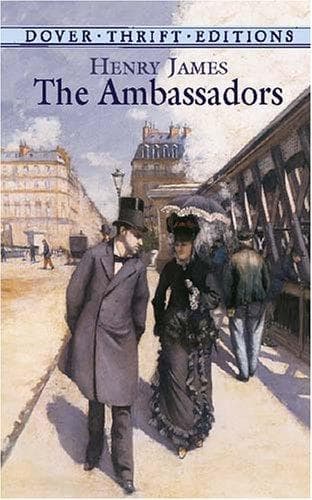
Americans -- France -- Fiction; Man-woman relationships -- Fiction; Paris (France) -- Fiction; Psychological fiction; Young men -- Fiction
“Yes, I do—to the extent that I don’t take for granted vulgar ones.
You’re perfectly capable of seeing that what you came out for wasn’t
really at all to do what you’d now have to do.”
“Ah it’s perfectly simple,” Strether good-humouredly pleaded. “I’ve had
but one thing to do—to put our case before him. To put it as it could
only be put here on the spot—by personal pressure. My dear lady,” he
lucidly pursued, “my work, you see, is really done, and my reasons for
staying on even another day are none of the best. Chad’s in possession
of our case and professes to do it full justice. What remains is with
himself. I’ve had my rest, my amusement and refreshment; I’ve had, as
we say at Woollett, a lovely time. Nothing in it has been more lovely
than this happy meeting with you—in these fantastic conditions to which
you’ve so delightfully consented. I’ve a sense of success. It’s what I
wanted. My getting all this good is what Chad has waited for, and I
gather that if I’m ready to go he’s the same.”
She shook her head with a finer deeper wisdom. “You’re not ready. If
you’re ready why did you write to Mrs. Newsome in the sense you’ve
mentioned to me?”
Strether considered. “I shan’t go before I hear from her. You’re too
much afraid of her,” he added.
It produced between them a long look from which neither shrank. “I
don’t think you believe that—believe I’ve not really reason to fear
her.”
“She’s capable of great generosity,” Strether presently stated.
“Well then let her trust me a little. That’s all I ask. Let her
recognise in spite of everything what I’ve done.”
“Ah remember,” our friend replied, “that she can’t effectually
recognise it without seeing it for herself. Let Chad go over and show
her what you’ve done, and let him plead with her there for it and, as
it were, for _you_.”
She measured the depth of this suggestion. “Do you give me your word of
honour that if she once has him there she won’t do her best to marry
him?”
It made her companion, this enquiry, look again a while out at the
view; after which he spoke without sharpness. “When she sees for
herself what he is—”
But she had already broken in. “It’s when she sees for herself what he
is that she’ll want to marry him most.”
Strether’s attitude, that of due deference to what she said, permitted
him to attend for a minute to his luncheon. “I doubt if that will come
off. It won’t be easy to make it.”
“It will be easy if he remains there—and he’ll remain for the money.
The money appears to be, as a probability, so hideously much.”
“Well,” Strether presently concluded, “nothing _could_ really hurt you
but his marrying.”
She gave a strange light laugh. “Putting aside what may really hurt
_him_.”
But her friend looked at her as if he had thought of that too. “The
question will come up, of course, of the future that you yourself offer
him.”
She was leaning back now, but she fully faced him. “Well, let it come
up!”
Public-domain text, read in full here on John Shaqi.
Reviews
Reviews
No reviews yet
Be the first to share your thoughts on this work.
Elsewhere in the archive
Join the Discussion
Join the discussion
Sign in to leave a comment or review.
Sign InorCreate an account