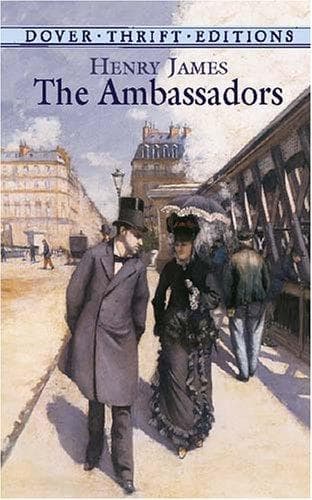
Americans -- France -- Fiction; Man-woman relationships -- Fiction; Paris (France) -- Fiction; Psychological fiction; Young men -- Fiction
“I see, I see”—she had easily understood. “Mr. Newsome will do the
same, and that’s not”—she laughed out now—“to be thought of.”
Strether had no laugh; he had only a quiet comparatively placid look
that might have shown him as proof against ridicule. “Strange, isn’t
it?”
They had, in the matter that so much interested them, come so far as
this without sounding another name—to which however their present
momentary silence was full of a conscious reference. Strether’s
question was a sufficient implication of the weight it had gained with
him during the absence of his hostess; and just for that reason a
single gesture from her could pass for him as a vivid answer. Yet he
was answered still better when she said in a moment: “Will Mr. Newsome
introduce his sister—?”
“To Madame de Vionnet?” Strether spoke the name at last. “I shall be
greatly surprised if he doesn’t.”
She seemed to gaze at the possibility. “You mean you’ve thought of it
and you’re prepared.”
“I’ve thought of it and I’m prepared.”
It was to her visitor now that she applied her consideration. “Bon! You
_are_ magnificent!”
“Well,” he answered after a pause and a little wearily, but still
standing there before her—“well, that’s what, just once in all my dull
days, I think I shall like to have been!”
Two days later he had news from Chad of a communication from Woollett
in response to their determinant telegram, this missive being addressed
to Chad himself and announcing the immediate departure for France of
Sarah and Jim and Mamie. Strether had meanwhile on his own side cabled;
he had but delayed that act till after his visit to Miss Gostrey, an
interview by which, as so often before, he felt his sense of things
cleared up and settled. His message to Mrs. Newsome, in answer to her
own, had consisted of the words: “Judge best to take another month, but
with full appreciation of all re-enforcements.” He had added that he
was writing, but he was of course always writing; it was a practice
that continued, oddly enough, to relieve him, to make him come nearer
than anything else to the consciousness of doing something: so that he
often wondered if he hadn’t really, under his recent stress, acquired
some hollow trick, one of the specious arts of make-believe. Wouldn’t
the pages he still so freely dispatched by the American post have been
worthy of a showy journalist, some master of the great new science of
beating the sense out of words? Wasn’t he writing against time, and
mainly to show he was kind?—since it had become quite his habit not to
like to read himself over. On those lines he could still be liberal,
yet it was at best a sort of whistling in the dark. It was
unmistakeable moreover that the sense of being in the dark now pressed
on him more sharply—creating thereby the need for a louder and livelier
whistle. He whistled long and hard after sending his message; he
whistled again and again in celebration of Chad’s news; there was an
Public-domain text, read in full here on John Shaqi.
Reviews
Reviews
No reviews yet
Be the first to share your thoughts on this work.
Elsewhere in the archive
Join the Discussion
Join the discussion
Sign in to leave a comment or review.
Sign InorCreate an account