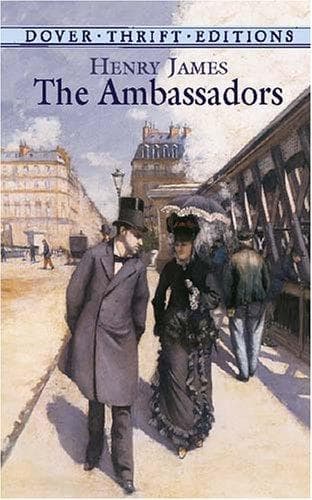
Americans -- France -- Fiction; Man-woman relationships -- Fiction; Paris (France) -- Fiction; Psychological fiction; Young men -- Fiction
This made for independence on Strether’s part, and he had in truth at
no moment of his stay been so free to go and come. The early summer
brushed the picture over and blurred everything but the near; it made a
vast warm fragrant medium in which the elements floated together on the
best of terms, in which rewards were immediate and reckonings
postponed. Chad was out of town again, for the first time since his
visitor’s first view of him; he had explained this necessity—without
detail, yet also without embarrassment, the circumstance was one of
those which, in the young man’s life, testified to the variety of his
ties. Strether wasn’t otherwise concerned with it than for its so
testifying—a pleasant multitudinous image in which he took comfort. He
took comfort, by the same stroke, in the swing of Chad’s pendulum back
from that other swing, the sharp jerk towards Woollett, so stayed by
his own hand. He had the entertainment of thinking that if he had for
that moment stopped the clock it was to promote the next minute this
still livelier motion. He himself did what he hadn’t done before; he
took two or three times whole days off—irrespective of others, of two
or three taken with Miss Gostrey, two or three taken with little
Bilham: he went to Chartres and cultivated, before the front of the
cathedral, a general easy beatitude; he went to Fontainebleau and
imagined himself on the way to Italy; he went to Rouen with a little
handbag and inordinately spent the night.
One afternoon he did something quite different; finding himself in the
neighbourhood of a fine old house across the river, he passed under the
great arch of its doorway and asked at the porter’s lodge for Madame de
Vionnet. He had already hovered more than once about that possibility,
been aware of it, in the course of ostensible strolls, as lurking but
round the corner. Only it had perversely happened, after his morning at
Notre Dame, that his consistency, as he considered and intended it, had
come back to him; whereby he had reflected that the encounter in
question had been none of his making; clinging again intensely to the
strength of his position, which was precisely that there was nothing in
it for himself. From the moment he actively pursued the charming
associate of his adventure, from that moment his position weakened, for
he was then acting in an interested way. It was only within a few days
that he had fixed himself a limit: he promised himself his consistency
should end with Sarah’s arrival. It was arguing correctly to feel the
title to a free hand conferred on him by this event. If he wasn’t to be
let alone he should be merely a dupe to act with delicacy. If he wasn’t
to be trusted he could at least take his ease. If he was to be placed
under control he gained leave to try what his position _might_
agreeably give him. An ideal rigour would perhaps postpone the trial
till after the Pococks had shown their spirit; and it was to an ideal
Public-domain text, read in full here on John Shaqi.
Reviews
Reviews
No reviews yet
Be the first to share your thoughts on this work.
Elsewhere in the archive
Join the Discussion
Join the discussion
Sign in to leave a comment or review.
Sign InorCreate an account