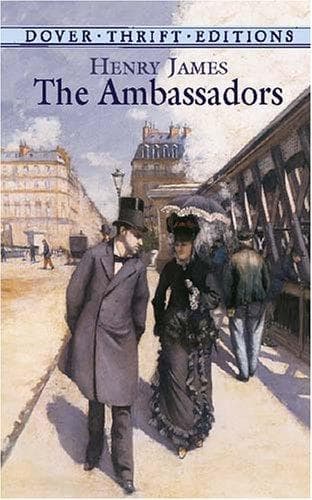
Americans -- France -- Fiction; Man-woman relationships -- Fiction; Paris (France) -- Fiction; Psychological fiction; Young men -- Fiction
Strether _was_ then as much as ever the valued friend of her family, it
was something he could at all events go on with; and the manner of his
response to it expressed even for himself how little he had enjoyed the
prospect of ceasing to figure in that likeness. He had always seen
Sarah gracious—had in fact rarely seen her shy or dry, her marked
thin-lipped smile, intense without brightness and as prompt to act as
the scrape of a safety-match; the protrusion of her rather remarkably
long chin, which in her case represented invitation and urbanity, and
not, as in most others, pugnacity and defiance; the penetration of her
voice to a distance, the general encouragement and approval of her
manner, were all elements with which intercourse had made him familiar,
but which he noted today almost as if she had been a new acquaintance.
This first glimpse of her had given a brief but vivid accent to her
resemblance to her mother; he could have taken her for Mrs. Newsome
while she met his eyes as the train rolled into the station. It was an
impression that quickly dropped; Mrs. Newsome was much handsomer, and
while Sarah inclined to the massive her mother had, at an age, still
the girdle of a maid; also the latter’s chin was rather short, than
long, and her smile, by good fortune, much more, oh ever so much more,
mercifully vague. Strether had seen Mrs. Newsome reserved; he had
literally heard her silent, though he had never known her unpleasant.
It was the case with Mrs. Pocock that he had known _her_ unpleasant,
even though he had never known her not affable. She had forms of
affability that were in a high degree assertive; nothing for instance
had ever been more striking than that she was affable to Jim.
What had told in any case at the window of the train was her high clear
forehead, that forehead which her friends, for some reason, always
thought of as a “brow”; the long reach of her eyes—it came out at this
juncture in such a manner as to remind him, oddly enough, also of that
of Waymarsh’s; and the unusual gloss of her dark hair, dressed and
hatted, after her mother’s refined example, with such an avoidance of
extremes that it was always spoken of at Woollett as “their own.”
Though this analogy dropped as soon as she was on the platform it had
lasted long enough to make him feel all the advantage, as it were, of
his relief. The woman at home, the woman to whom he was attached, was
before him just long enough to give him again the measure of the
wretchedness, in fact really of the shame, of their having to recognise
the formation, between them, of a “split.” He had taken this measure in
solitude and meditation: but the catastrophe, as Sarah steamed up,
looked for its seconds unprecedentedly dreadful—or proved, more
exactly, altogether unthinkable; so that his finding something free and
familiar to respond to brought with it an instant renewal of his
loyalty. He had suddenly sounded the whole depth, had gasped at what he
might have lost.
Public-domain text, read in full here on John Shaqi.
Reviews
Reviews
No reviews yet
Be the first to share your thoughts on this work.
Elsewhere in the archive
Join the Discussion
Join the discussion
Sign in to leave a comment or review.
Sign InorCreate an account