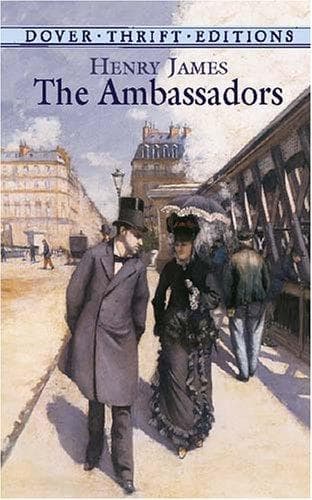
Americans -- France -- Fiction; Man-woman relationships -- Fiction; Paris (France) -- Fiction; Psychological fiction; Young men -- Fiction
“Yes, literally—dear Jim! He’s awful. What _he_ wants, heaven forgive
him, is to help us.”
“You mean”—she was eager—“help _me?_”
“Well, Chad and me in the first place. But he throws you in too, though
without as yet seeing you much. Only, so far as he does see you—if you
don’t mind—he sees you as awful.”
“‘Awful’?”—she wanted it all.
“A regular bad one—though of course of a tremendously superior kind.
Dreadful, delightful, irresistible.”
“Ah dear Jim! I should like to know him. I _must_.”
“Yes, naturally. But will it do? You may, you know,” Strether
suggested, “disappoint him.”
She was droll and humble about it. “I can but try. But my wickedness
then,” she went on, “is my recommendation for him?”
“Your wickedness and the charms with which, in such a degree as yours,
he associates it. He understands, you see, that Chad and I have above
all wanted to have a good time, and his view is simple and sharp.
Nothing will persuade him—in the light, that is, of my behaviour—that I
really didn’t, quite as much as Chad, come over to have one before it
was too late. He wouldn’t have expected it of me; but men of my age, at
Woollett—and especially the least likely ones—have been noted as liable
to strange outbreaks, belated uncanny clutches at the unusual, the
ideal. It’s an effect that a lifetime of Woollett has quite been
observed as having; and I thus give it to you, in Jim’s view, for what
it’s worth. Now his wife and his mother-in-law,” Strether continued to
explain, “have, as in honour bound, no patience with such phenomena,
late or early—which puts Jim, as against his relatives, on the other
side. Besides,” he added, “I don’t think he really wants Chad back. If
Chad doesn’t come—”
“He’ll have”—Madame de Vionnet quite apprehended—“more of the free
hand?”
“Well, Chad’s the bigger man.”
“So he’ll work now, _en dessous_, to keep him quiet?”
“No—he won’t ‘work’ at all, and he won’t do anything _en dessous_. He’s
very decent and won’t be a traitor in the camp. But he’ll be amused
with his own little view of our duplicity, he’ll sniff up what he
supposes to be Paris from morning till night, and he’ll be, as to the
rest, for Chad—well, just what he is.”
She thought it over. “A warning?”
He met it almost with glee. “You _are_ as wonderful as everybody says!”
And then to explain all he meant: “I drove him about for his first
hour, and do you know what—all beautifully unconscious—he most put
before me? Why that something like _that_ is at bottom, as an
improvement to his present state, as in fact the real redemption of it,
what they think it may not be too late to make of our friend.” With
which, as, taking it in, she seemed, in her recurrent alarm, bravely to
gaze at the possibility, he completed his statement. “But it _is_ too
late. Thanks to you!”
It drew from her again one of her indefinite reflexions. “Oh ‘me’—after
all!”
Public-domain text, read in full here on John Shaqi.
Reviews
Reviews
No reviews yet
Be the first to share your thoughts on this work.
Elsewhere in the archive
Join the Discussion
Join the discussion
Sign in to leave a comment or review.
Sign InorCreate an account