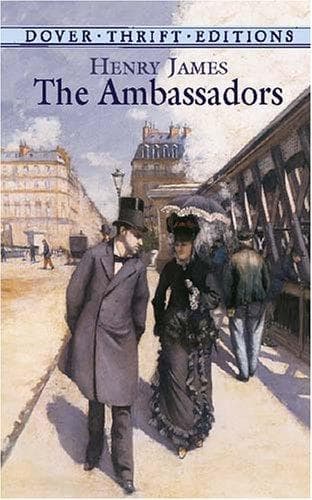
Americans -- France -- Fiction; Man-woman relationships -- Fiction; Paris (France) -- Fiction; Psychological fiction; Young men -- Fiction
“Well, we’re bad enough perhaps, thank heaven,” she laughed, “to upset
them! Mr. Waymarsh at any rate is a hideous old coquette.” And the next
moment she had dropped everything for a different pursuit. “What you
don’t appear to know is that Jeanne de Vionnet has become engaged.
She’s to marry—it has been definitely arranged—young Monsieur de
Montbron.”
He fairly blushed. “Then—if you know it—it’s ‘out’?”
“Don’t I often know things that are _not_ out? However,” she said,
“this will be out to-morrow. But I see I’ve counted too much on your
possible ignorance. You’ve been before me, and I don’t make you jump as
I hoped.”
He gave a gasp at her insight. “You never fail! I’ve _had_ my jump. I
had it when I first heard.”
“Then if you knew why didn’t you tell me as soon as you came in?”
“Because I had it from her as a thing not yet to be spoken of.”
Miss Gostrey wondered. “From Madame de Vionnet herself?”
“As a probability—not quite a certainty: a good cause in which Chad has
been working. So I’ve waited.”
“You need wait no longer,” she returned. “It reached me
yesterday—roundabout and accidental, but by a person who had had it
from one of the young man’s own people—as a thing quite settled. I was
only keeping it for you.”
“You thought Chad wouldn’t have told me?”
She hesitated. “Well, if he hasn’t—”
“He hasn’t. And yet the thing appears to have been practically his
doing. So there we are.”
“There we are!” Maria candidly echoed.
“That’s why I jumped. I jumped,” he continued to explain, “because it
means, this disposition of the daughter, that there’s now nothing else:
nothing else but him and the mother.”
“Still—it simplifies.”
“It simplifies”—he fully concurred. “But that’s precisely where we are.
It marks a stage in his relation. The act is his answer to Mrs.
Newsome’s demonstration.”
“It tells,” Maria asked, “the worst?”
“The worst.”
“But is the worst what he wants Sarah to know?”
“He doesn’t care for Sarah.”
At which Miss Gostrey’s eyebrows went up. “You mean she has already
dished herself?”
Strether took a turn about; he had thought it out again and again
before this, to the end; but the vista seemed each time longer. “He
wants his good friend to know the best. I mean the measure of his
attachment. She asked for a sign, and he thought of that one. There it
is.”
“A concession to her jealousy?”
Strether pulled up. “Yes—call it that. Make it lurid—for that makes my
problem richer.”
“Certainly, let us have it lurid—for I quite agree with you that we
want none of our problems poor. But let us also have it clear. Can he,
in the midst of such a preoccupation, or on the heels of it, have
seriously cared for Jeanne?—cared, I mean, as a young man at liberty
would have cared?”
Well, Strether had mastered it. “I think he can have thought it would
be charming if he _could_ care. It would be nicer.”
“Nicer than being tied up to Marie?”
Public-domain text, read in full here on John Shaqi.
Reviews
Reviews
No reviews yet
Be the first to share your thoughts on this work.
Elsewhere in the archive
Join the Discussion
Join the discussion
Sign in to leave a comment or review.
Sign InorCreate an account