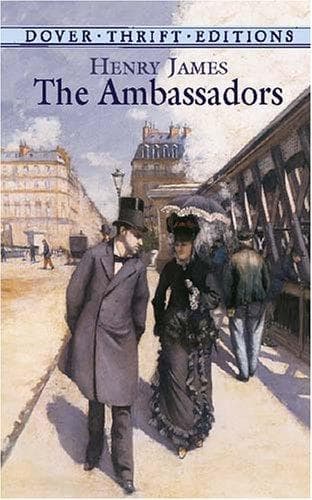
Americans -- France -- Fiction; Man-woman relationships -- Fiction; Paris (France) -- Fiction; Psychological fiction; Young men -- Fiction
Miss Gostrey, however, wouldn’t let it depend on anything—wouldn’t have
it, and wouldn’t want him, at any price. “It suits my book,” she said,
“that he should be impossible; and it suits it still better,” she more
imaginatively added, “that Mrs. Newsome doesn’t know he is.”
Strether, in consequence, had to take it from her, but he fell back on
something else. “I’ll tell you who does really know.”
“Mr. Waymarsh? Never!”
“Never indeed. I’m not _always_ thinking of Mr. Waymarsh; in fact I
find now I never am.” Then he mentioned the person as if there were a
good deal in it. “Mamie.”
“His own sister?” Oddly enough it but let her down. “What good will
that do?”
“None perhaps. But there—as usual—we are!”
III
There they were yet again, accordingly, for two days more; when
Strether, on being, at Mrs. Pocock’s hotel, ushered into that lady’s
salon, found himself at first assuming a mistake on the part of the
servant who had introduced him and retired. The occupants hadn’t come
in, for the room looked empty as only a room can look in Paris, of a
fine afternoon when the faint murmur of the huge collective life,
carried on out of doors, strays among scattered objects even as a
summer air idles in a lonely garden. Our friend looked about and
hesitated; observed, on the evidence of a table charged with purchases
and other matters, that Sarah had become possessed—by no aid from
_him_—of the last number of the salmon-coloured Revue; noted further
that Mamie appeared to have received a present of Fromentin’s “Maîtres
d’Autrefois” from Chad, who had written her name on the cover; and
pulled up at the sight of a heavy letter addressed in a hand he knew.
This letter, forwarded by a banker and arriving in Mrs. Pocock’s
absence, had been placed in evidence, and it drew from the fact of its
being unopened a sudden queer power to intensify the reach of its
author. It brought home to him the scale on which Mrs. Newsome—for she
had been copious indeed this time—was writing to her daughter while she
kept _him_ in durance; and it had altogether such an effect upon him as
made him for a few minutes stand still and breathe low. In his own
room, at his own hotel, he had dozens of well-filled envelopes
superscribed in that character; and there was actually something in the
renewal of his interrupted vision of the character that played straight
into the so frequent question of whether he weren’t already
disinherited beyond appeal. It was such an assurance as the sharp
downstrokes of her pen hadn’t yet had occasion to give him; but they
somehow at the present crisis stood for a probable absoluteness in any
decree of the writer. He looked at Sarah’s name and address, in short,
as if he had been looking hard into her mother’s face, and then turned
from it as if the face had declined to relax. But since it was in a
manner as if Mrs. Newsome were thereby all the more, instead of the
less, in the room, and were conscious, sharply and sorely conscious, of
Public-domain text, read in full here on John Shaqi.
Reviews
Reviews
No reviews yet
Be the first to share your thoughts on this work.
Elsewhere in the archive
Join the Discussion
Join the discussion
Sign in to leave a comment or review.
Sign InorCreate an account