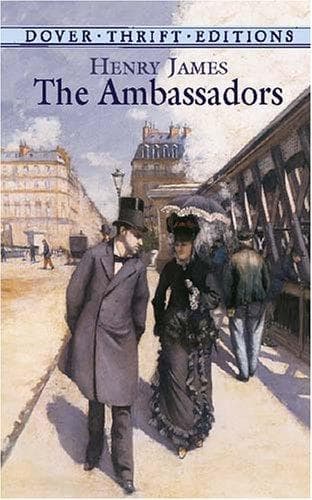
Americans -- France -- Fiction; Man-woman relationships -- Fiction; Paris (France) -- Fiction; Psychological fiction; Young men -- Fiction
It fully came up for them then, by means of their talking of everything
_but_ Chad, that Mamie, unlike Sarah, unlike Jim, knew perfectly what
had become of him. It fully came up that she had taken to the last
fraction of an inch the measure of the change in him, and that she
wanted Strether to know what a secret she proposed to make of it. They
talked most conveniently—as if they had had no chance yet—about
Woollett; and that had virtually the effect of their keeping the secret
more close. The hour took on for Strether, little by little, a queer
sad sweetness of quality, he had such a revulsion in Mamie’s favour and
on behalf of her social value as might have come from remorse at some
early injustice. She made him, as under the breath of some vague
western whiff, homesick and freshly restless; he could really for the
time have fancied himself stranded with her on a far shore, during an
ominous calm, in a quaint community of shipwreck. Their little
interview was like a picnic on a coral strand; they passed each other,
with melancholy smiles and looks sufficiently allusive, such cupfuls of
water as they had saved. Especially sharp in Strether meanwhile was the
conviction that his companion really knew, as we have hinted, where she
had come out. It was at a very particular place—only _that_ she would
never tell him; it would be above all what he should have to puzzle for
himself. This was what he hoped for, because his interest in the girl
wouldn’t be complete without it. No more would the appreciation to
which she was entitled—so assured was he that the more he saw of her
process the more he should see of her pride. She saw, herself,
everything; but she knew what she didn’t want, and that it was that had
helped her. What didn’t she want?—there was a pleasure lost for her old
friend in not yet knowing, as there would doubtless be a thrill in
getting a glimpse. Gently and sociably she kept that dark to him, and
it was as if she soothed and beguiled him in other ways to make up for
it. She came out with her impression of Madame de Vionnet—of whom she
had “heard so much”; she came out with her impression of Jeanne, whom
she had been “dying to see”: she brought it out with a blandness by
which her auditor was really stirred that she had been with Sarah early
that very afternoon, and after dreadful delays caused by all sorts of
things, mainly, eternally, by the purchase of clothes—clothes that
unfortunately wouldn’t be themselves eternal—to call in the Rue de
Bellechasse.
Public-domain text, read in full here on John Shaqi.
Reviews
Reviews
No reviews yet
Be the first to share your thoughts on this work.
Elsewhere in the archive
Join the Discussion
Join the discussion
Sign in to leave a comment or review.
Sign InorCreate an account