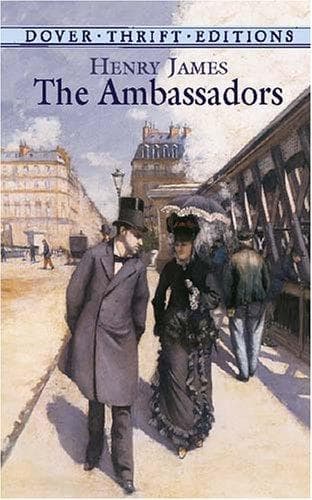
Americans -- France -- Fiction; Man-woman relationships -- Fiction; Paris (France) -- Fiction; Psychological fiction; Young men -- Fiction
She was willing to take it that way. “Oh yes, I know everything.” And
as she sat there rubbing her polished hands and making the best of
it—only holding her elbows perhaps a little too much out—the momentary
effect for Strether was that every one else, in all their affair,
seemed stupid.
“Know that poor little Jeanne doesn’t know what’s the matter with her?”
It was as near as they came to saying that she was probably in love
with Chad; but it was quite near enough for what Strether wanted; which
was to be confirmed in his certitude that, whether in love or not, she
appealed to something large and easy in the girl before him. Mamie
would be fat, too fat, at thirty; but she would always be the person
who, at the present sharp hour, had been disinterestedly tender. “If I
see a little more of her, as I hope I shall, I think she’ll like me
enough—for she seemed to like me to-day—to want me to tell her.”
“And _shall_ you?”
“Perfectly. I shall tell her the matter with her is that she wants only
too much to do right. To do right for her, naturally,” said Mamie, “is
to please.”
“Her mother, do you mean?”
“Her mother first.”
Strether waited. “And then?”
“Well, ‘then’—Mr. Newsome.”
There was something really grand for him in the serenity of this
reference. “And last only Monsieur de Montbron?”
“Last only”—she good-humouredly kept it up.
Strether considered. “So that every one after all then will be suited?”
She had one of her few hesitations, but it was a question only of a
moment; and it was her nearest approach to being explicit with him
about what was between them. “I think I can speak for myself. _I_ shall
be.”
It said indeed so much, told such a story of her being ready to help
him, so committed to him that truth, in short, for such use as he might
make of it toward those ends of his own with which, patiently and
trustfully, she had nothing to do—it so fully achieved all this that he
appeared to himself simply to meet it in its own spirit by the last
frankness of admiration. Admiration was of itself almost accusatory,
but nothing less would serve to show her how nearly he understood. He
put out his hand for good-bye with a “Splendid, splendid, splendid!”
And he left her, in her splendour, still waiting for little Bilham.
Book Tenth
I
Public-domain text, read in full here on John Shaqi.
Reviews
Reviews
No reviews yet
Be the first to share your thoughts on this work.
Elsewhere in the archive
Join the Discussion
Join the discussion
Sign in to leave a comment or review.
Sign InorCreate an account