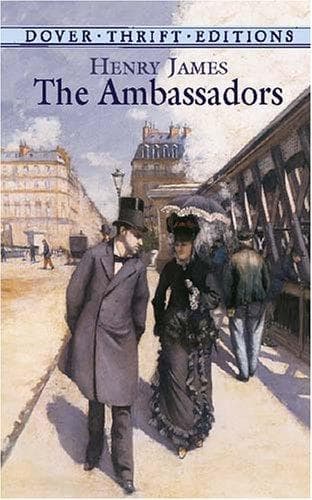
Americans -- France -- Fiction; Man-woman relationships -- Fiction; Paris (France) -- Fiction; Psychological fiction; Young men -- Fiction
He had felt of old—for it already seemed long ago—rather humiliated at
discovering he could learn in talk with a personage so much his junior
the lesson of a certain moral ease; but he had now got used to
that—whether or no the mixture of the fact with other humiliations had
made it indistinct, whether or no directly from little Bilham’s
example, the example of his being contentedly just the obscure and
acute little Bilham he was. It worked so for him, Strether seemed to
see; and our friend had at private hours a wan smile over the fact that
he himself, after so many more years, was still in search of something
that would work. However, as we have said, it worked just now for them
equally to have found a corner a little apart. What particularly kept
it apart was the circumstance that the music in the salon was
admirable, with two or three such singers as it was a privilege to hear
in private. Their presence gave a distinction to Chad’s entertainment,
and the interest of calculating their effect on Sarah was actually so
sharp as to be almost painful. Unmistakeably, in her single person, the
motive of the composition and dressed in a splendour of crimson which
affected Strether as the sound of a fall through a skylight, she would
now be in the forefront of the listening circle and committed by it up
to her eyes. Those eyes during the wonderful dinner itself he hadn’t
once met; having confessedly—perhaps a little pusillanimously—arranged
with Chad that he should be on the same side of the table. But there
was no use in having arrived now with little Bilham at an unprecedented
point of intimacy unless he could pitch everything into the pot. “You
who sat where you could see her, what does she make of it all? By which
I mean on what terms does she take it?”
“Oh she takes it, I judge, as proving that the claim of his family is
more than ever justified.”
“She isn’t then pleased with what he has to show?”
“On the contrary; she’s pleased with it as with his capacity to do this
kind of thing—more than she has been pleased with anything for a long
time. But she wants him to show it _there_. He has no right to waste it
on the likes of us.”
Strether wondered. “She wants him to move the whole thing over?”
“The whole thing—with an important exception. Everything he has ‘picked
up’—and the way he knows how. She sees no difficulty in that. She’d run
the show herself, and she’ll make the handsome concession that Woollett
would be on the whole in some ways the better for it. Not that it
wouldn’t be also in some ways the better for Woollett. The people there
are just as good.”
“Just as good as you and these others? Ah that may be. But such an
occasion as this, whether or no,” Strether said, “isn’t the people.
It’s what has made the people possible.”
Public-domain text, read in full here on John Shaqi.
Reviews
Reviews
No reviews yet
Be the first to share your thoughts on this work.
Elsewhere in the archive
Join the Discussion
Join the discussion
Sign in to leave a comment or review.
Sign InorCreate an account