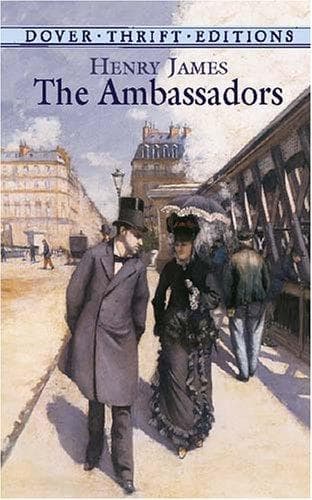
Americans -- France -- Fiction; Man-woman relationships -- Fiction; Paris (France) -- Fiction; Psychological fiction; Young men -- Fiction
“Well, I mean that I somehow feel to-night—on her behalf—too good to be
true. She has had her cake; that is she’s in the act now of having it,
of swallowing the largest and sweetest piece. There won’t be another
left for her. Certainly _I_ haven’t one. It can only, at the best, be
Chad.” He continued to make it out as for their common entertainment.
“He may have one, as it were, up his sleeve; yet it’s borne in upon me
that if he had—”
“He wouldn’t”—she quite understood—“have taken all _this_ trouble? I
dare say not, and, if I may be quite free and dreadful, I very much
hope he won’t take any more. Of course I won’t pretend now,” she added,
“not to know what it’s a question of.”
“Oh every one must know now,” poor Strether thoughtfully admitted; “and
it’s strange enough and funny enough that one should feel everybody
here at this very moment to be knowing and watching and waiting.”
“Yes—isn’t it indeed funny?” Miss Barrace quite rose to it. “That’s the
way we _are_ in Paris.” She was always pleased with a new contribution
to that queerness. “It’s wonderful! But, you know,” she declared, “it
all depends on you. I don’t want to turn the knife in your vitals, but
that’s naturally what you just now meant by our all being on top of
you. We know you as the hero of the drama, and we’re gathered to see
what you’ll do.”
Strether looked at her a moment with a light perhaps slightly obscured.
“I think that must be why the hero has taken refuge in this corner.
He’s scared at his heroism—he shrinks from his part.”
“Ah but we nevertheless believe he’ll play it. That’s why,” Miss
Barrace kindly went on, “we take such an interest in you. We feel
you’ll come up to the scratch.” And then as he seemed perhaps not quite
to take fire: “Don’t let him do it.”
“Don’t let Chad go?”
“Yes, keep hold of him. With all this”—and she indicated the general
tribute—“he has done enough. We love him here—he’s charming.”
“It’s beautiful,” said Strether, “the way you all can simplify when you
will.”
But she gave it to him back. “It’s nothing to the way _you_ will when
you must.”
He winced at it as at the very voice of prophecy, and it kept him a
moment quiet. He detained her, however, on her appearing about to leave
him alone in the rather cold clearance their talk had made. “There
positively isn’t a sign of a hero to-night; the hero’s dodging and
shirking, the hero’s ashamed. Therefore, you know, I think, what you
must all _really_ be occupied with is the heroine.”
Miss Barrace took a minute. “The heroine?”
“The heroine. I’ve treated her,” said Strether, “not a bit like a hero.
Oh,” he sighed, “I don’t do it well!”
She eased him off. “You do it as you can.” And then after another
hesitation: “I think she’s satisfied.”
But he remained compunctious. “I haven’t been near her. I haven’t
looked at her.”
“Ah then you’ve lost a good deal!”
He showed he knew it. “She’s more wonderful than ever?”
“Than ever. With Mr. Pocock.”
Public-domain text, read in full here on John Shaqi.
Reviews
Reviews
No reviews yet
Be the first to share your thoughts on this work.
Elsewhere in the archive
Join the Discussion
Join the discussion
Sign in to leave a comment or review.
Sign InorCreate an account