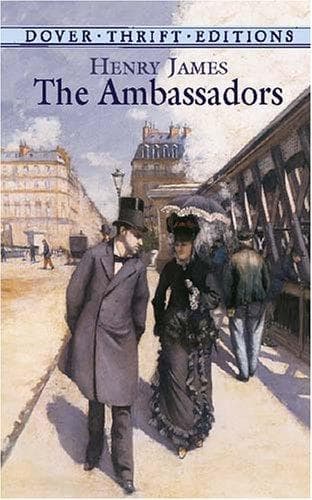
Americans -- France -- Fiction; Man-woman relationships -- Fiction; Paris (France) -- Fiction; Psychological fiction; Young men -- Fiction
He was never in the morning very late, but Waymarsh had already been
out, and, after a peep into the dim refectory, he presented himself
with much less than usual of his large looseness. He had made sure,
through the expanse of glass exposed to the court, that they would be
alone; and there was now in fact that about him that pretty well took
up the room. He was dressed in the garments of summer; and save that
his white waistcoat was redundant and bulging these things favoured,
they determined, his expression. He wore a straw hat such as his friend
hadn’t yet seen in Paris, and he showed a buttonhole freshly adorned
with a magnificent rose. Strether read on the instant his story—how,
astir for the previous hour, the sprinkled newness of the day, so
pleasant at that season in Paris, he was fairly panting with the pulse
of adventure and had been with Mrs. Pocock, unmistakeably, to the
Marché aux Fleurs. Strether really knew in this vision of him a joy
that was akin to envy; so reversed as he stood there did their old
positions seem; so comparatively doleful now showed, by the sharp turn
of the wheel, the posture of the pilgrim from Woollett. He wondered,
this pilgrim, if he had originally looked to Waymarsh so brave and
well, so remarkably launched, as it was at present the latter’s
privilege to appear. He recalled that his friend had remarked to him
even at Chester that his aspect belied his plea of prostration; but
there certainly couldn’t have been, for an issue, an aspect less
concerned than Waymarsh’s with the menace of decay. Strether had at any
rate never resembled a Southern planter of the great days—which was the
image picturesquely suggested by the happy relation between the
fuliginous face and the wide panama of his visitor. This type, it
further amused him to guess, had been, on Waymarsh’s part, the object
of Sarah’s care; he was convinced that her taste had not been a
stranger to the conception and purchase of the hat, any more than her
fine fingers had been guiltless of the bestowal of the rose. It came to
him in the current of thought, as things so oddly did come, that _he_
had never risen with the lark to attend a brilliant woman to the Marché
aux Fleurs; this could be fastened on him in connexion neither with
Miss Gostrey nor with Madame de Vionnet; the practice of getting up
early for adventures could indeed in no manner be fastened on him. It
came to him in fact that just here was his usual case: he was for ever
missing things through his general genius for missing them, while
others were for ever picking them up through a contrary bent. And it
was others who looked abstemious and he who looked greedy; it was he
somehow who finally paid, and it was others who mainly partook. Yes, he
should go to the scaffold yet for he wouldn’t know quite whom. He
almost, for that matter, felt on the scaffold now and really quite
enjoying it. It worked out as _because_ he was anxious there—it worked
Public-domain text, read in full here on John Shaqi.
Reviews
Reviews
No reviews yet
Be the first to share your thoughts on this work.
Elsewhere in the archive
Join the Discussion
Join the discussion
Sign in to leave a comment or review.
Sign InorCreate an account