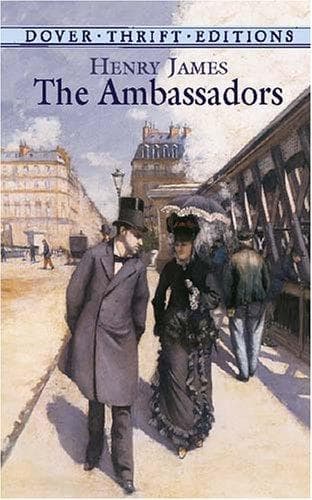
Americans -- France -- Fiction; Man-woman relationships -- Fiction; Paris (France) -- Fiction; Psychological fiction; Young men -- Fiction
“Well, I told her you had. And she has been waiting too.” It was, in
the oddest way in the world, on the showing of this tone, a genial new
pressing coaxing Waymarsh; a Waymarsh conscious with a different
consciousness from any he had yet betrayed, and actually rendered by it
almost insinuating. He lacked only time for full persuasion, and
Strether was to see in a moment why. Meantime, however, our friend
perceived, he was announcing a step of some magnanimity on Mrs.
Pocock’s part, so that he could deprecate a sharp question. It was his
own high purpose in fact to have smoothed sharp questions to rest. He
looked his old comrade very straight in the eyes, and he had never
conveyed to him in so mute a manner so much kind confidence and so much
good advice. Everything that was between them was again in his face,
but matured and shelved and finally disposed of. “At any rate,” he
added, “she’s coming now.”
Considering how many pieces had to fit themselves, it all fell, in
Strether’s brain, into a close rapid order. He saw on the spot what had
happened, and what probably would yet; and it was all funny enough. It
was perhaps just this freedom of appreciation that wound him up to his
flare of high spirits. “What is she coming _for?_—to kill me?”
“She’s coming to be very _very_ kind to you, and you must let me say
that I greatly hope you’ll not be less so to herself.”
This was spoken by Waymarsh with much gravity of admonition, and as
Strether stood there he knew he had but to make a movement to take the
attitude of a man gracefully receiving a present. The present was that
of the opportunity dear old Waymarsh had flattered himself he had
divined in him the slight soreness of not having yet thoroughly
enjoyed; so he had brought it to him thus, as on a little silver
breakfast-tray, familiarly though delicately—without oppressive pomp;
and he was to bend and smile and acknowledge, was to take and use and
be grateful. He was not—that was the beauty of it—to be asked to
deflect too much from his dignity. No wonder the old boy bloomed in
this bland air of his own distillation. Strether felt for a moment as
if Sarah were actually walking up and down outside. Wasn’t she hanging
about the _porte-cochère_ while her friend thus summarily opened a way?
Strether would meet her but to take it, and everything would be for the
best in the best of possible worlds. He had never so much known what
any one meant as, in the light of this demonstration, he knew what Mrs.
Newsome did. It had reached Waymarsh from Sarah, but it had reached
Sarah from her mother, and there was no break in the chain by which it
reached _him_. “Has anything particular happened,” he asked after a
minute—“so suddenly to determine her? Has she heard anything unexpected
from home?”
Waymarsh, on this, it seemed to him, looked at him harder than ever.
“‘Unexpected’?” He had a brief hesitation; then, however, he was firm.
“We’re leaving Paris.”
“Leaving? That _is_ sudden.”
Public-domain text, read in full here on John Shaqi.
Reviews
Reviews
No reviews yet
Be the first to share your thoughts on this work.
Elsewhere in the archive
Join the Discussion
Join the discussion
Sign in to leave a comment or review.
Sign InorCreate an account