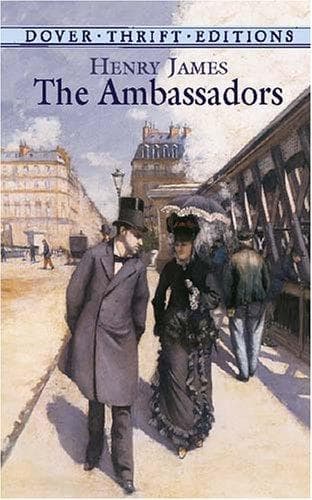
Americans -- France -- Fiction; Man-woman relationships -- Fiction; Paris (France) -- Fiction; Psychological fiction; Young men -- Fiction
produce on me by alluding to her in such terms? It’s as if you had some
motive in not recognising all she has done for your brother, and so
shut your eyes to each side of the matter, in order, whichever side
comes up, to get rid of the other. I don’t, you must allow me to say,
see how you can with any pretence to candour get rid of the side
nearest you.”
“Near me—_that_ sort of thing?” And Sarah gave a jerk back of her head
that well might have nullified any active proximity.
It kept her friend himself at his distance, and he respected for a
moment the interval. Then with a last persuasive effort he bridged it.
“You don’t, on your honour, appreciate Chad’s fortunate development?”
“Fortunate?” she echoed again. And indeed she was prepared. “I call it
hideous.”
Her departure had been for some minutes marked as imminent, and she was
already at the door that stood open to the court, from the threshold of
which she delivered herself of this judgement. It rang out so loud as
to produce for the time the hush of everything else. Strether quite, as
an effect of it, breathed less bravely; he could acknowledge it, but
simply enough. “Oh if you think _that_—!”
“Then all’s at an end? So much the better. I do think that!” She passed
out as she spoke and took her way straight across the court, beyond
which, separated from them by the deep arch of the _porte-cochère_ the
low victoria that had conveyed her from her own hotel was drawn up. She
made for it with decision, and the manner of her break, the sharp shaft
of her rejoinder, had an intensity by which Strether was at first kept
in arrest. She had let fly at him as from a stretched cord, and it took
him a minute to recover from the sense of being pierced. It was not the
penetration of surprise; it was that, much more, of certainty; his case
being put for him as he had as yet only put it to himself. She was away
at any rate; she had distanced him—with rather a grand spring, an
effect of pride and ease, after all; she had got into her carriage
before he could overtake her, and the vehicle was already in motion. He
stopped halfway; he stood there in the court only seeing her go and
noting that she gave him no other look. The way he had put it to
himself was that all quite _might_ be at an end. Each of her movements,
in this resolute rupture, reaffirmed, re-enforced that idea. Sarah
passed out of sight in the sunny street while, planted there in the
centre of the comparatively grey court, he continued merely to look
before him. It probably _was_ all at an end.
Book Eleventh
[Note: In the 1909 New York Edition the following two chapters were
placed in the reverse of the order appearing below. Since 1950, most
scholars have agreed, because of the internal evidence of the two
chapters, that an editorial error caused them to be printed in reverse
order. This Etext, like other editions of the past four decades,
corrects the apparent error.—Richard D. Hathaway, preparer of this
electronic text]
I
Public-domain text, read in full here on John Shaqi.
Reviews
Reviews
No reviews yet
Be the first to share your thoughts on this work.
Elsewhere in the archive
Join the Discussion
Join the discussion
Sign in to leave a comment or review.
Sign InorCreate an account