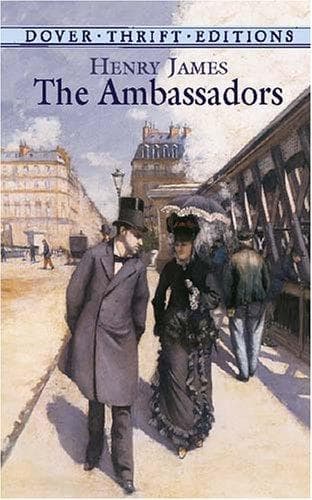
Americans -- France -- Fiction; Man-woman relationships -- Fiction; Paris (France) -- Fiction; Psychological fiction; Young men -- Fiction
He spent a long time on the balcony; he hung over it as he had seen
little Bilham hang the day of his first approach, as he had seen Mamie
hang over her own the day little Bilham himself might have seen her
from below; he passed back into the rooms, the three that occupied the
front and that communicated by wide doors; and, while he circulated and
rested, tried to recover the impression that they had made on him three
months before, to catch again the voice in which they had seemed then
to speak to him. That voice, he had to note, failed audibly to sound;
which he took as the proof of all the change in himself. He had heard,
of old, only what he _could_ then hear; what he could do now was to
think of three months ago as a point in the far past. All voices had
grown thicker and meant more things; they crowded on him as he moved
about—it was the way they sounded together that wouldn’t let him be
still. He felt, strangely, as sad as if he had come for some wrong, and
yet as excited as if he had come for some freedom. But the freedom was
what was most in the place and the hour, it was the freedom that most
brought him round again to the youth of his own that he had long ago
missed. He could have explained little enough to-day either why he had
missed it or why, after years and years, he should care that he had;
the main truth of the actual appeal of everything was none the less
that everything represented the substance of his loss put it within
reach, within touch, made it, to a degree it had never been, an affair
of the senses. That was what it became for him at this singular time,
the youth he had long ago missed—a queer concrete presence, full of
mystery, yet full of reality, which he could handle, taste, smell, the
deep breathing of which he could positively hear. It was in the outside
air as well as within; it was in the long watch, from the balcony, in
the summer night, of the wide late life of Paris, the unceasing soft
quick rumble, below, of the little lighted carriages that, in the
press, always suggested the gamblers he had seen of old at Monte Carlo
pushing up to the tables. This image was before him when he at last
became aware that Chad was behind.
Public-domain text, read in full here on John Shaqi.
Reviews
Reviews
No reviews yet
Be the first to share your thoughts on this work.
Elsewhere in the archive
Join the Discussion
Join the discussion
Sign in to leave a comment or review.
Sign InorCreate an account