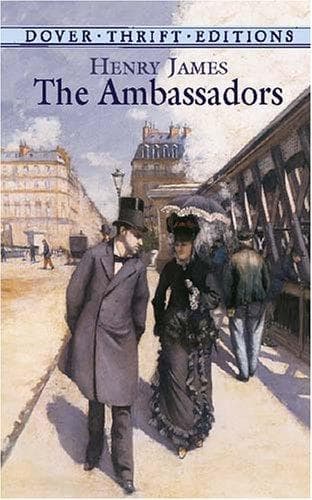
Americans -- France -- Fiction; Man-woman relationships -- Fiction; Paris (France) -- Fiction; Psychological fiction; Young men -- Fiction
On which—though as if for an instant it had hung fire—Chad remarkably
replied: “Well, if they hate my good friend, _that_ comes to the same
thing.” It had a note of inevitable truth that made Strether take it as
enough, feel he wanted nothing more. The young man spoke in it for his
“good friend” more than he had ever yet directly spoken, confessed to
such deep identities between them as he might play with the idea of
working free from, but which at a given moment could still draw him
down like a whirlpool. And meanwhile he had gone on. “Their hating you
too moreover—that also comes to a good deal.”
“Ah,” said Strether, “your mother doesn’t.”
Chad, however, loyally stuck to it—loyally, that is, to Strether. “She
will if you don’t look out.”
“Well, I do look out. I am, after all, looking out. That’s just why,”
our friend explained, “I want to see her again.”
It drew from Chad again the same question. “To see Mother?”
“To see—for the present—Sarah.”
“Ah then there you are! And what I don’t for the life of me make out,”
Chad pursued with resigned perplexity, “is what you _gain_ by it.”
Oh it would have taken his companion too long to say! “That’s because
you have, I verily believe, no imagination. You’ve other qualities. But
no imagination, don’t you see? at all.”
“I dare say. I do see.” It was an idea in which Chad showed interest.
“But haven’t you yourself rather too much?”
“Oh _rather_—!” So that after an instant, under this reproach and as if
it were at last a fact really to escape from, Strether made his move
for departure.
II
One of the features of the restless afternoon passed by him after Mrs.
Pocock’s visit was an hour spent, shortly before dinner, with Maria
Gostrey, whom of late, in spite of so sustained a call on his attention
from other quarters, he had by no means neglected. And that he was
still not neglecting her will appear from the fact that he was with her
again at the same hour on the very morrow—with no less fine a
consciousness moreover of being able to hold her ear. It continued
inveterately to occur, for that matter, that whenever he had taken one
of his greater turns he came back to where she so faithfully awaited
him. None of these excursions had on the whole been livelier than the
pair of incidents—the fruit of the short interval since his previous
visit—on which he had now to report to her. He had seen Chad Newsome
late the night before, and he had had that morning, as a sequel to this
conversation, a second interview with Sarah. “But they’re all off,” he
said, “at last.”
It puzzled her a moment. “All?—Mr. Newsome with them?”
“Ah not yet! Sarah and Jim and Mamie. But Waymarsh with them—for Sarah.
It’s too beautiful,” Strether continued; “I find I don’t get over
that—it’s always a fresh joy. But it’s a fresh joy too,” he added,
“that—well, what do you think? Little Bilham also goes. But he of
course goes for Mamie.”
Miss Gostrey wondered. “‘For’ her? Do you mean they’re already
engaged?”
Public-domain text, read in full here on John Shaqi.
Reviews
Reviews
No reviews yet
Be the first to share your thoughts on this work.
Elsewhere in the archive
Join the Discussion
Join the discussion
Sign in to leave a comment or review.
Sign InorCreate an account