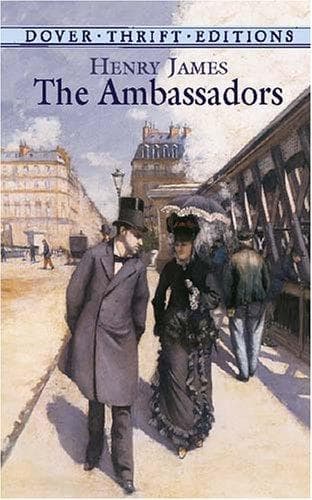
Americans -- France -- Fiction; Man-woman relationships -- Fiction; Paris (France) -- Fiction; Psychological fiction; Young men -- Fiction
“Oh,” she objected, “it won’t be as a part of the picturesqueness that
I shall stay, for I shall be the plainest thing about you. You may, you
see, at any rate,” she pursued, “have nobody else. Madame de Vionnet
may very well be going off, mayn’t she?—and Mr. Newsome by the same
stroke: unless indeed you’ve had an assurance from them to the
contrary. So that if your idea’s to stay for them”—it was her duty to
suggest it—“you may be left in the lurch. Of course if they do
stay”—she kept it up—“they would be part of the picturesqueness. Or
else indeed you might join them somewhere.”
Strether seemed to face it as if it were a happy thought; but the next
moment he spoke more critically. “Do you mean that they’ll probably go
off together?”
She just considered. “I think it will be treating you quite without
ceremony if they do; though after all,” she added, “it would be
difficult to see now quite what degree of ceremony properly meets your
case.”
“Of course,” Strether conceded, “my attitude toward them is
extraordinary.”
“Just so; so that one may ask one’s self what style of proceeding on
their own part can altogether match it. The attitude of their own that
won’t pale in its light they’ve doubtless still to work out. The really
handsome thing perhaps,” she presently threw off, “_would_ be for them
to withdraw into more secluded conditions, offering at the same time to
share them with you.” He looked at her, on this, as if some generous
irritation—all in his interest—had suddenly again flickered in her; and
what she next said indeed half-explained it. “Don’t really be afraid to
tell me if what now holds you _is_ the pleasant prospect of the empty
town, with plenty of seats in the shade, cool drinks, deserted museums,
drives to the Bois in the evening, and our wonderful woman all to
yourself.” And she kept it up still more. “The handsomest thing of
_all_, when one makes it out, would, I dare say, be that Mr. Chad
should for a while go off by himself. It’s a pity, from that point of
view,” she wound up, “that he doesn’t pay his mother a visit. It would
at least occupy your interval.” The thought in fact held her a moment.
“Why doesn’t he pay his mother a visit? Even a week, at this good
moment, would do.”
“My dear lady,” Strether replied—and he had it even to himself
surprisingly ready—“my dear lady, his mother has paid _him_ a visit.
Mrs. Newsome has been with him, this month, with an intensity that I’m
sure he has thoroughly felt; he has lavishly entertained her, and she
has let him have her thanks. Do you suggest he shall go back for more
of them?”
Well, she succeeded after a little in shaking it off. “I see. It’s what
you don’t suggest—what you haven’t suggested. And you know.”
“So would you, my dear,” he kindly said, “if you had so much as seen
her.”
“As seen Mrs. Newsome?”
“No, Sarah—which, both for Chad and for myself, has served all the
purpose.”
“And served it in a manner,” she responsively mused, “so
extraordinary!”
Public-domain text, read in full here on John Shaqi.
Reviews
Reviews
No reviews yet
Be the first to share your thoughts on this work.
Elsewhere in the archive
Join the Discussion
Join the discussion
Sign in to leave a comment or review.
Sign InorCreate an account