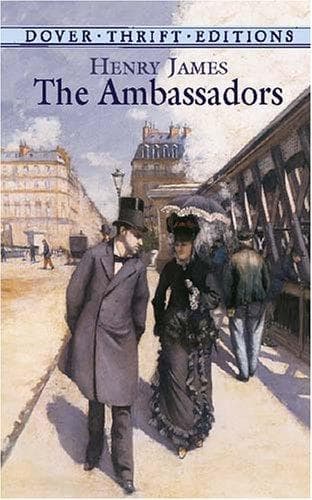
Americans -- France -- Fiction; Man-woman relationships -- Fiction; Paris (France) -- Fiction; Psychological fiction; Young men -- Fiction
Once more he stopped before her as if she had touched the point.
“That’s just her difficulty—that she doesn’t admit surprises. It’s a
fact that, I think, describes and represents her; and it falls in with
what I tell you—that she’s all, as I’ve called it, fine cold thought.
She had, to her own mind, worked the whole thing out in advance, and
worked it out for me as well as for herself. Whenever she has done
that, you see, there’s no room left; no margin, as it were, for any
alteration. She’s filled as full, packed as tight, as she’ll hold and
if you wish to get anything more or different either out or in—”
“You’ve got to make over altogether the woman herself?”
“What it comes to,” said Strether, “is that you’ve got morally and
intellectually to get rid of her.”
“Which would appear,” Maria returned, “to be practically what you’ve
done.”
But her friend threw back his head. “I haven’t touched her. She won’t
_be_ touched. I see it now as I’ve never done; and she hangs together
with a perfection of her own,” he went on, “that does suggest a kind of
wrong in _any_ change of her composition. It was at any rate,” he wound
up, “the woman herself, as you call her the whole moral and
intellectual being or block, that Sarah brought me over to take or to
leave.”
It turned Miss Gostrey to deeper thought. “Fancy having to take at the
point of the bayonet a whole moral and intellectual being or block!”
“It was in fact,” said Strether, “what, at home, I _had_ done. But
somehow over there I didn’t quite know it.”
“One never does, I suppose,” Miss Gostrey concurred, “realise in
advance, in such a case, the size, as you may say, of the block. Little
by little it looms up. It has been looming for you more and more till
at last you see it all.”
“I see it all,” he absently echoed, while his eyes might have been
fixing some particularly large iceberg in a cool blue northern sea.
“It’s magnificent!” he then rather oddly exclaimed.
But his friend, who was used to this kind of inconsequence in him, kept
the thread. “There’s nothing so magnificent—for making others feel
you—as to have no imagination.”
It brought him straight round. “Ah there you are! It’s what I said last
night to Chad. That he himself, I mean, has none.”
“Then it would appear,” Maria suggested, “that he has, after all,
something in common with his mother.”
“He has in common that he makes one, as you say, ‘feel’ him. And yet,”
he added, as if the question were interesting, “one feels others too,
even when they have plenty.”
Miss Gostrey continued suggestive. “Madame de Vionnet?”
“_She_ has plenty.”
“Certainly—she had quantities of old. But there are different ways of
making one’s self felt.”
“Yes, it comes, no doubt, to that. You now—”
He was benevolently going on, but she wouldn’t have it. “Oh I _don’t_
make myself felt; so my quantity needn’t be settled. Yours, you know,”
she said, “is monstrous. No one has ever had so much.”
Public-domain text, read in full here on John Shaqi.
Reviews
Reviews
No reviews yet
Be the first to share your thoughts on this work.
Elsewhere in the archive
Join the Discussion
Join the discussion
Sign in to leave a comment or review.
Sign InorCreate an account