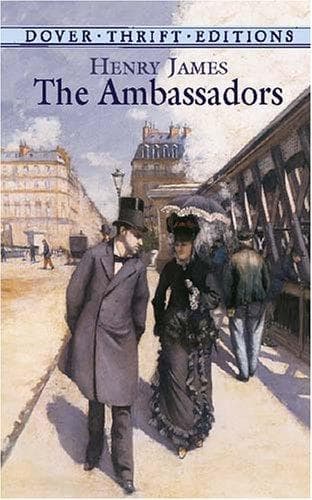
Americans -- France -- Fiction; Man-woman relationships -- Fiction; Paris (France) -- Fiction; Psychological fiction; Young men -- Fiction
pocket—he should sufficiently command the scene to be able to pick out
just the right little rustic inn for an experiment in respect to
dinner. There was a train back to Paris at 9.20, and he saw himself
partaking, at the close of the day, with the enhancements of a coarse
white cloth and a sanded door, of something fried and felicitous,
washed down with authentic wine; after which he might, as he liked,
either stroll back to his station in the gloaming or propose for the
local _carriole_ and converse with his driver, a driver who naturally
wouldn’t fail of a stiff clean blouse, of a knitted nightcap and of the
genius of response—who, in fine, would sit on the shafts, tell him what
the French people were thinking, and remind him, as indeed the whole
episode would incidentally do, of Maupassant. Strether heard his lips,
for the first time in French air, as this vision assumed consistency,
emit sounds of expressive intention without fear of his company. He had
been afraid of Chad and of Maria and of Madame de Vionnet; he had been
most of all afraid of Waymarsh, in whose presence, so far as they had
mixed together in the light of the town, he had never without somehow
paying for it aired either his vocabulary or his accent. He usually
paid for it by meeting immediately afterwards Waymarsh’s eye.
Such were the liberties with which his fancy played after he had turned
off to the hillside that did really and truly, as well as most amiably,
await him beneath the poplars, the hillside that made him feel, for a
murmurous couple of hours, how happy had been his thought. He had the
sense of success, of a finer harmony in things; nothing but what had
turned out as yet according to his plan. It most of all came home to
him, as he lay on his back on the grass, that Sarah had really gone,
that his tension was really relaxed; the peace diffused in these ideas
might be delusive, but it hung about him none the less for the time. It
fairly, for half an hour, sent him to sleep; he pulled his straw hat
over his eyes—he had bought it the day before with a reminiscence of
Waymarsh’s—and lost himself anew in Lambinet. It was as if he had found
out he was tired—tired not from his walk, but from that inward exercise
which had known, on the whole, for three months, so little
intermission. That was it—when once they were off he had dropped; this
moreover was what he had dropped to, and now he was touching bottom. He
was kept luxuriously quiet, soothed and amused by the consciousness of
what he had found at the end of his descent. It was very much what he
had told Maria Gostrey he should like to stay on for, the
hugely-distributed Paris of summer, alternately dazzling and dusky,
with a weight lifted for him off its columns and cornices and with
shade and air in the flutter of awnings as wide as avenues. It was
present to him without attenuation that, reaching out, the day after
making the remark, for some proof of his freedom, he had gone that very
Public-domain text, read in full here on John Shaqi.
Reviews
Reviews
No reviews yet
Be the first to share your thoughts on this work.
Elsewhere in the archive
Join the Discussion
Join the discussion
Sign in to leave a comment or review.
Sign InorCreate an account