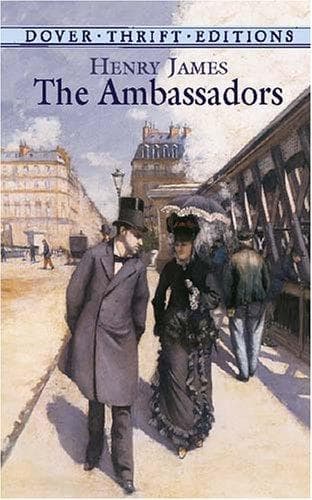
Americans -- France -- Fiction; Man-woman relationships -- Fiction; Paris (France) -- Fiction; Psychological fiction; Young men -- Fiction
He had only had to be at last well out
of it to feel it, oddly enough, still going on.
For this had been all day at bottom the spell of the picture—that it
was essentially more than anything else a scene and a stage, that the
very air of the play was in the rustle of the willows and the tone of
the sky. The play and the characters had, without his knowing it till
now, peopled all his space for him, and it seemed somehow quite happy
that they should offer themselves, in the conditions so supplied, with
a kind of inevitability. It was as if the conditions made them not only
inevitable, but so much more nearly natural and right as that they were
at least easier, pleasanter, to put up with. The conditions had nowhere
so asserted their difference from those of Woollett as they appeared to
him to assert it in the little court of the Cheval Blanc while he
arranged with his hostess for a comfortable climax. They were few and
simple, scant and humble, but they were _the thing_, as he would have
called it, even to a greater degree than Madame de Vionnet’s old high
salon where the ghost of the Empire walked. “The” thing was the thing
that implied the greatest number of other things of the sort he had had
to tackle; and it was queer of course, but so it was—the implication
here was complete. Not a single one of his observations but somehow
fell into a place in it; not a breath of the cooler evening that wasn’t
somehow a syllable of the text. The text was simply, when condensed,
that in _these_ places such things were, and that if it was in them one
elected to move about one had to make one’s account with what one
lighted on. Meanwhile at all events it was enough that they did affect
one—so far as the village aspect was concerned—as whiteness,
crookedness and blueness set in coppery green; there being positively,
for that matter, an outer wall of the White Horse that was painted the
most improbable shade. That was part of the amusement—as if to show
that the fun was harmless; just as it was enough, further, that the
picture and the play seemed supremely to melt together in the good
woman’s broad sketch of what she could do for her visitor’s appetite.
He felt in short a confidence, and it was general, and it was all he
wanted to feel. It suffered no shock even on her mentioning that she
had in fact just laid the cloth for two persons who, unlike Monsieur,
had arrived by the river—in a boat of their own; who had asked her,
half an hour before, what she could do for them, and had then paddled
away to look at something a little further up—from which promenade they
would presently return. Monsieur might meanwhile, if he liked, pass
into the garden, such as it was, where she would serve him, should he
wish it—for there were tables and benches in plenty—a “bitter” before
his repast. Here she would also report to him on the possibility of a
conveyance to his station, and here at any rate he would have the
_agrément_ of the river.
Public-domain text, read in full here on John Shaqi.
Reviews
Reviews
No reviews yet
Be the first to share your thoughts on this work.
Elsewhere in the archive
Join the Discussion
Join the discussion
Sign in to leave a comment or review.
Sign InorCreate an account