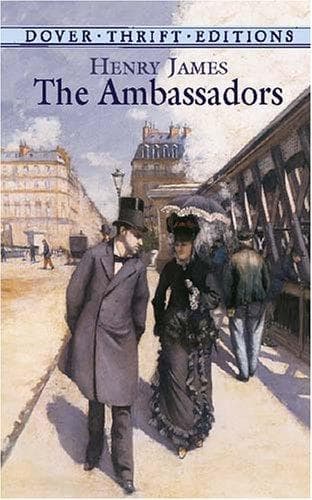
Americans -- France -- Fiction; Man-woman relationships -- Fiction; Paris (France) -- Fiction; Psychological fiction; Young men -- Fiction
There was none other, however, than the common and constant pressure,
familiar to our friend under the rubric of _Postes et Télégraphes_—the
something in the air of these establishments; the vibration of the vast
strange life of the town, the influence of the types, the performers
concocting their messages; the little prompt Paris women, arranging,
pretexting goodness knew what, driving the dreadful needle-pointed
public pen at the dreadful sand-strewn public table: implements that
symbolised for Strether’s too interpretative innocence something more
acute in manners, more sinister in morals, more fierce in the national
life. After he had put in his paper he had ranged himself, he was
really amused to think, on the side of the fierce, the sinister, the
acute. He was carrying on a correspondence, across the great city,
quite in the key of the _Postes et Télégraphes_ in general; and it was
fairly as if the acceptance of that fact had come from something in his
state that sorted with the occupation of his neighbours. He was mixed
up with the typical tale of Paris, and so were they, poor things—how
could they all together help being? They were no worse than he, in
short, and he no worse than they—if, queerly enough, no better; and at
all events he had settled his hash, so that he went out to begin, from
that moment, his day of waiting. The great settlement was, as he felt,
in his preference for seeing his correspondent in her own best
conditions. _That_ was part of the typical tale, the part most
significant in respect to himself. He liked the place she lived in, the
picture that each time squared itself, large and high and clear, around
her: every occasion of seeing it was a pleasure of a different shade.
Yet what precisely was he doing with shades of pleasure now, and why
hadn’t he properly and logically compelled her to commit herself to
whatever of disadvantage and penalty the situation might throw up? He
might have proposed, as for Sarah Pocock, the cold hospitality of his
own _salon de lecture_, in which the chill of Sarah’s visit seemed
still to abide and shades of pleasure were dim; he might have suggested
a stone bench in the dusty Tuileries or a penny chair at the back part
of the Champs Elysées. These things would have been a trifle stern, and
sternness alone now wouldn’t be sinister. An instinct in him cast about
for some form of discipline in which they might meet—some awkwardness
they would suffer from, some danger, or at least some grave
inconvenience, they would incur. This would give a sense—which the
spirit required, rather ached and sighed in the absence of—that
somebody was paying something somewhere and somehow, that they were at
least not all floating together on the silver stream of impunity. Just
instead of that to go and see her late in the evening, as if, for all
the world—well, as if he were as much in the swim as anybody else: this
had as little as possible in common with the penal form.
Public-domain text, read in full here on John Shaqi.
Reviews
Reviews
No reviews yet
Be the first to share your thoughts on this work.
Elsewhere in the archive
Join the Discussion
Join the discussion
Sign in to leave a comment or review.
Sign InorCreate an account