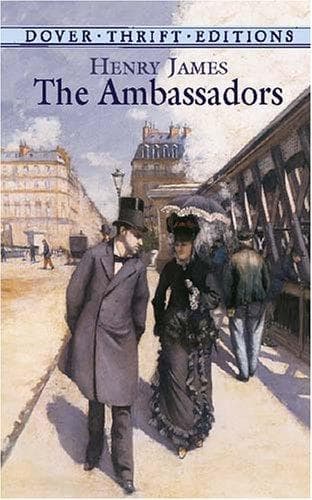
Americans -- France -- Fiction; Man-woman relationships -- Fiction; Paris (France) -- Fiction; Psychological fiction; Young men -- Fiction
But she threw off at last, with a sharp sad headshake, drying her eyes,
what he could still do. “I don’t care for that. Of course, as I’ve
said, you’re acting, in your wonderful way, for yourself; and what’s
for yourself is no more my business—though I may reach out unholy hands
so clumsily to touch it—than if it were something in Timbuctoo. It’s
only that you don’t snub me, as you’ve had fifty chances to do—it’s
only your beautiful patience that makes one forget one’s manners. In
spite of your patience, all the same,” she went on, “you’d do anything
rather than be with us here, even if that were possible. You’d do
everything for us but be mixed up with us—which is a statement you can
easily answer to the advantage of your own manners. You can say ‘What’s
the use of talking of things that at the best are impossible?’ What
_is_ of course the use? It’s only my little madness. You’d talk if you
were tormented. And I don’t mean now about _him_. Oh for him—!”
Positively, strangely, bitterly, as it seemed to Strether, she gave
“him,” for the moment, away. “You don’t care what I think of you; but I
happen to care what you think of me. And what you _might_,” she added.
“What you perhaps even did.”
He gained time. “What I did—?”
“Did think before. Before this. _Didn’t_ you think—?”
But he had already stopped her. “I didn’t think anything. I never think
a step further than I’m obliged to.”
“That’s perfectly false, I believe,” she returned—“except that you may,
no doubt, often pull up when things become _too_ ugly; or even, I’ll
say, to save you a protest, too beautiful. At any rate, even so far as
it’s true, we’ve thrust on you appearances that you’ve had to take in
and that have therefore made your obligation. Ugly or beautiful—it
doesn’t matter what we call them—you were getting on without them, and
that’s where we’re detestable. We bore you—that’s where we are. And we
may well—for what we’ve cost you. All you can do _now_ is not to think
at all. And I who should have liked to seem to you—well, sublime!”
He could only after a moment re-echo Miss Barrace. “You’re wonderful!”
“I’m old and abject and hideous”—she went on as without hearing him.
“Abject above all. Or old above all. It’s when one’s old that it’s
worst. I don’t care what becomes of it—let what _will_; there it is.
It’s a doom—I know it; you can’t see it more than I do myself. Things
have to happen as they will.” With which she came back again to what,
face to face with him, had so quite broken down. “Of course you
wouldn’t, even if possible, and no matter what may happen to you, be
near us. But think of me, think of me—!” She exhaled it into air.
He took refuge in repeating something he had already said and that she
had made nothing of. “There’s something I believe I can still do.” And
he put his hand out for good-bye.
She again made nothing of it; she went on with her insistence. “That
won’t help you. There’s nothing to help you.”
“Well, it may help _you_,” he said.
Public-domain text, read in full here on John Shaqi.
Reviews
Reviews
No reviews yet
Be the first to share your thoughts on this work.
Elsewhere in the archive
Join the Discussion
Join the discussion
Sign in to leave a comment or review.
Sign InorCreate an account