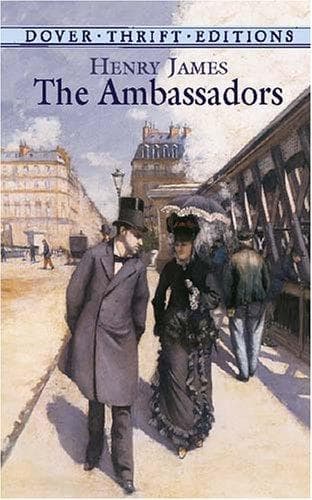
Americans -- France -- Fiction; Man-woman relationships -- Fiction; Paris (France) -- Fiction; Psychological fiction; Young men -- Fiction
“It was to talk to me,” Maria returned; on which he was further sure
that she was practically in possession of what he himself hadn’t yet
told her. He was even sure she was in possession of things he himself
couldn’t have told; for the consciousness of them was now all in her
face and accompanied there with a shade of sadness that marked in her
the close of all uncertainties. It came out for him more than ever yet
that she had had from the first a knowledge she believed him not to
have had, a knowledge the sharp acquisition of which might be destined
to make a difference for him. The difference for him might not
inconceivably be an arrest of his independence and a change in his
attitude—in other words a revulsion in favour of the principles of
Woollett. She had really prefigured the possibility of a shock that
would send him swinging back to Mrs. Newsome. He hadn’t, it was true,
week after week, shown signs of receiving it, but the possibility had
been none the less in the air. What Maria accordingly had had now to
take in was that the shock had descended and that he hadn’t, all the
same, swung back. He had grown clear, in a flash, on a point long since
settled for herself; but no reapproximation to Mrs. Newsome had
occurred in consequence. Madame de Vionnet had by her visit held up the
torch to these truths, and what now lingered in poor Maria’s face was
the somewhat smoky light of the scene between them. If the light
however wasn’t, as we have hinted, the glow of joy, the reasons for
this also were perhaps discernible to Strether even through the blur
cast over them by his natural modesty. She had held herself for months
with a firm hand; she hadn’t interfered on any chance—and chances were
specious enough—that she might interfere to her profit. She had turned
her back on the dream that Mrs. Newsome’s rupture, their friend’s
forfeiture—the engagement, the relation itself, broken beyond all
mending—might furnish forth her advantage; and, to stay her hand from
promoting these things, she had on private, difficult, but rigid,
lines, played strictly fair. She couldn’t therefore but feel that,
though, as the end of all, the facts in question had been stoutly
confirmed, her ground for personal, for what might have been called
interested, elation remained rather vague. Strether might easily have
made out that she had been asking herself, in the hours she had just
sat through, if there were still for her, or were only not, a fair
shade of uncertainty. Let us hasten to add, however, that what he at
first made out on this occasion he also at first kept to himself. He
only asked what in particular Madame de Vionnet had come for, and as to
this his companion was ready.
“She wants tidings of Mr. Newsome, whom she appears not to have seen
for some days.”
“Then she hasn’t been away with him again?”
“She seemed to think,” Maria answered, “that he might have gone away
with _you_.”
“And did you tell her I know nothing of him?”
Public-domain text, read in full here on John Shaqi.
Reviews
Reviews
No reviews yet
Be the first to share your thoughts on this work.
Elsewhere in the archive
Join the Discussion
Join the discussion
Sign in to leave a comment or review.
Sign InorCreate an account