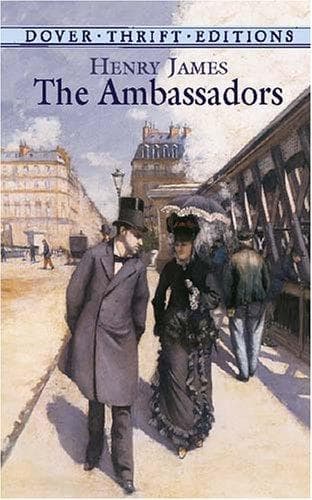
Americans -- France -- Fiction; Man-woman relationships -- Fiction; Paris (France) -- Fiction; Psychological fiction; Young men -- Fiction
“Ah of course,” sighed Strether, “I knew it. I believe you’re right. No
one in the world, I imagine, was ever so portentously solemn. There I
am,” he added with another sigh, as if weary enough, on occasion, of
this truth. “I was made so.”
Chad appeared for a little to consider the way he was made; he might
for this purpose have measured him up and down. His conclusion favoured
the fact. “_You_ have never needed any one to make you better. There
has never been any one good enough. They couldn’t,” the young man
declared.
His friend hesitated. “I beg your pardon. They _have_.”
Chad showed, not without amusement, his doubt. “Who then?”
Strether—though a little dimly—smiled at him. “Women—too.”
“‘Two’?”—Chad stared and laughed. “Oh I don’t believe, for such work,
in any more than one! So you’re proving too much. And what _is_
beastly, at all events,” he added, “is losing you.”
Strether had set himself in motion for departure, but at this he
paused. “Are you afraid?”
“Afraid—?”
“Of doing wrong. I mean away from my eye.” Before Chad could speak,
however, he had taken himself up. “I _am_, certainly,” he laughed,
“prodigious.”
“Yes, you spoil us for all the stupid—!” This might have been, on
Chad’s part, in its extreme emphasis, almost too freely extravagant;
but it was full, plainly enough, of the intention of comfort, it
carried with it a protest against doubt and a promise, positively, of
performance. Picking up a hat in the vestibule he came out with his
friend, came downstairs, took his arm, affectionately, as to help and
guide him, treating him if not exactly as aged and infirm, yet as a
noble eccentric who appealed to tenderness, and keeping on with him,
while they walked, to the next corner and the next. “You needn’t tell
me, you needn’t tell me!”—this again as they proceeded, he wished to
make Strether feel. What he needn’t tell him was now at last, in the
geniality of separation, anything at all it concerned him to know. He
knew, up to the hilt—that really came over Chad; he understood, felt,
recorded his vow; and they lingered on it as they had lingered in their
walk to Strether’s hotel the night of their first meeting. The latter
took, at this hour, all he could get; he had given all he had had to
give; he was as depleted as if he had spent his last sou. But there was
just one thing for which, before they broke off, Chad seemed disposed
slightly to bargain. His companion needn’t, as he said, tell him, but
he might himself mention that he had been getting some news of the art
of advertisement. He came out quite suddenly with this announcement
while Strether wondered if his revived interest were what had taken
him, with strange inconsequence, over to London. He appeared at all
events to have been looking into the question and had encountered a
revelation. Advertising scientifically worked presented itself thus as
the great new force. “It really does the thing, you know.”
Public-domain text, read in full here on John Shaqi.
Reviews
Reviews
No reviews yet
Be the first to share your thoughts on this work.
Elsewhere in the archive
Join the Discussion
Join the discussion
Sign in to leave a comment or review.
Sign InorCreate an account