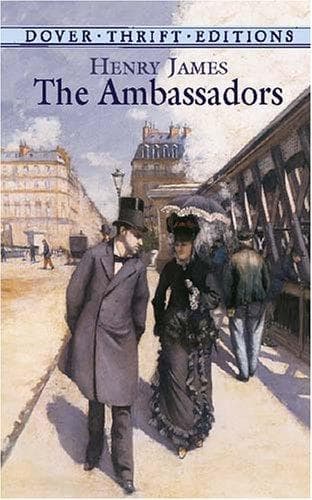
Americans -- France -- Fiction; Man-woman relationships -- Fiction; Paris (France) -- Fiction; Psychological fiction; Young men -- Fiction
She desired no further news of them,
and she mentioned that Madame de Vionnet herself had, to her knowledge,
lived exempt from the information he was ready to supply. She had never
consented to receive it, though she would have taken it, under stress,
from Mrs. Pocock. But it was a matter about which Mrs. Pocock appeared
to have had little to say—never sounding the word—and it didn’t signify
now. There was nothing clearly for Maria Gostrey that signified
now—save one sharp point, that is, to which she came in time. “I don’t
know whether it’s before you as a possibility that, left to himself,
Mr. Chad may after all go back. I judge that it _is_ more or less so
before you, from what you just now said of him.”
Her guest had his eyes on her, kindly but attentively, as if foreseeing
what was to follow this. “I don’t think it will be for the money.” And
then as she seemed uncertain: “I mean I don’t believe it will be for
that he’ll give her up.”
“Then he _will_ give her up?”
Strether waited a moment, rather slow and deliberate now, drawing out a
little this last soft stage, pleading with her in various suggestive
and unspoken ways for patience and understanding. “What were you just
about to ask me?”
“Is there anything he can do that would make you patch it up?”
“With Mrs. Newsome?”
Her assent, as if she had had a delicacy about sounding the name, was
only in her face; but she added with it: “Or is there anything he can
do that would make _her_ try it?”
“To patch it up with me?” His answer came at last in a conclusive
headshake. “There’s nothing any one can do. It’s over. Over for both of
us.”
Maria wondered, seemed a little to doubt. “Are you so sure for her?”
“Oh yes—sure now. Too much has happened. I’m different for her.”
She took it in then, drawing a deeper breath. “I see. So that as she’s
different for _you_—”
“Ah but,” he interrupted, “she’s not.” And as Miss Gostrey wondered
again: “She’s the same. She’s more than ever the same. But I do what I
didn’t before—I _see_ her.”
He spoke gravely and as if responsibly—since he had to pronounce; and
the effect of it was slightly solemn, so that she simply exclaimed
“Oh!” Satisfied and grateful, however, she showed in her own next words
an acceptance of his statement. “What then do you go home to?”
He had pushed his plate a little away, occupied with another side of
the matter; taking refuge verily in that side and feeling so moved that
he soon found himself on his feet. He was affected in advance by what
he believed might come from her, and he would have liked to forestall
it and deal with it tenderly; yet in the presence of it he wished still
more to be—though as smoothly as possible—deterrent and conclusive. He
put her question by for the moment; he told her more about Chad. “It
would have been impossible to meet me more than he did last night on
the question of the infamy of not sticking to her.”
“Is that what you called it for him—‘infamy’?”
Public-domain text, read in full here on John Shaqi.
Reviews
Reviews
No reviews yet
Be the first to share your thoughts on this work.
Elsewhere in the archive
Join the Discussion
Join the discussion
Sign in to leave a comment or review.
Sign InorCreate an account