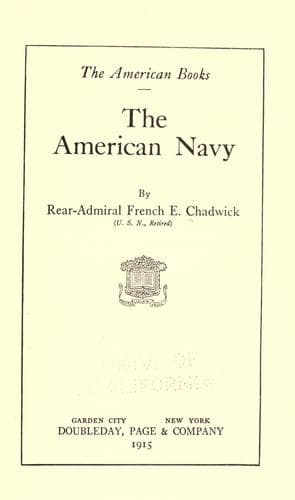
United States -- History, Naval; United States. Navy -- History
The losses of the navy in the war with Spain were extraordinarily
small. There were but sixteen killed and sixty-eight wounded, of whom
two died later. But even more remarkable, and it reflects the highest
praise upon the service, was the state of health of the 26,102 men
during this war of 114 days (April 21st to August 12th, inclusive).
There were but fifty-six deaths in this period from disease, or at the
rate of 6.85 per thousand a year. There were but thirteen cases of
typhoid fever, and no death aboard ship from this disease and but one
in hospital. There were but eighteen cases of dysentery. The marine
battalion at Guantánamo numbered 588--21 officers and 567 men. There
was no death from disease; only nineteen cases of malaria and no
typhoid.
The whole was a very remarkable showing; one never equalled elsewhere.
And it should be remembered that it was in a climate, and indeed very
largely in the same region, where, a century and a half before, the
crews of some British ships were so swept by disease that they had
in some cases to be renewed three times in but a moderate period
of service. The health conditions of the American fleet showed an
enlightened care which reflects honor upon all concerned.
* * * * *
The situation left us by the Spanish War is one which can be maintained
only by a powerful fleet, though our acquisitions in themselves
scarcely add to the necessity of such a fleet, for meanwhile we have
built the Panama Canal. And while the canal has lightened our strategic
difficulties in that our battle fleet can now reach San Francisco from
the Caribbean in a fourth of the time it took the _Oregon_ to make
her celebrated passage from San Francisco to Key West, there is upon
us the heavy burden of the defence of the isthmus, its position being
in effect insular. It can only remain in our hands by our controlling
the sea. Fortifications assist in its defence for the time being, but
should we go to war it must finally go into the hands of the power
with a superior navy. And being thus isolated and having this insular
character, the canal and its fortifications should be in naval control
in order that there should be complete unanimity of effort in its
defence.
It is safe to say that however anti-imperialist one may be, there
is no American who would see the canal go into foreign control with
equanimity. The most pronounced would halt at such a danger. Thus
whatever one’s attitude may be toward the Monroe Doctrine, there are
few who would not uphold the contention that we shall not permit any
further extension of foreign influence in the Caribbean or in any part
of the neighboring Pacific littoral, or in neighboring islands such as
the Galapagos. This is not a question of extension of influence, but of
safety.
Public-domain text, read in full here on John Shaqi.
Reviews
Reviews
No reviews yet
Be the first to share your thoughts on this work.
Elsewhere in the archive
Join the Discussion
Join the discussion
Sign in to leave a comment or review.
Sign InorCreate an account