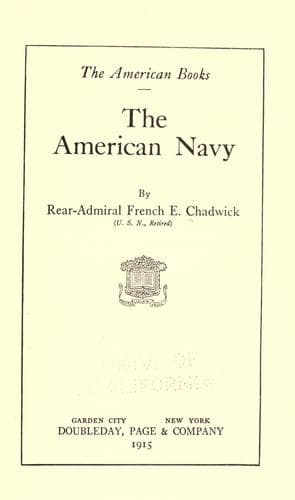
United States -- History, Naval; United States. Navy -- History
The series was planned long before the great war, but it has derived
added importance from the position which that great struggle has given
America on the face of the globe. The United States, standing aloof
from the suicidal bloodshed of the Old World, has necessarily become
the peaceful arbiter of the earth’s destinies and the flywheel to keep
the world’s industry revolving.
An inquiry into the meaning and tendency of American civilization
to-day is thus not only a matter of interest but of patriotic duty.
The publishers wish THE AMERICAN BOOKS to be a series of brief,
authoritative manuals which will attempt to lay bare some of the
problems that confront us to-day; written in popular terms that will
inspire rather than discourage the casual reader. The series should
prove not only of great interest to all American citizens who wish
to aid in solving their country’s pressing problems, but to every
foreigner visiting this country who seeks an interpretation of the
American point of view.
The publishers wish THE AMERICAN BOOKS to be written by the best men,
and to this end they seek the widest publicity for the plan. They will
be glad to receive suggestions as to appropriate titles for inclusion
in the series and will welcome authoritative MSS submitted from any
quarter. In particular they submit the plan to the consideration of the
American colleges where the problems of the country are being studied.
In science, literature, business, politics, in the arts of war and the
arts of peace, the publishers will seek writers who have stood for
fearless achievement or equally fearless failure, who will build up A
LIBRARY OF GOOD CITIZENSHIP.
(_For complete list of volumes in this series see opposite title
page._)
[Illustration]
THE COUNTRY LIFE PRESS
GARDEN CITY, N. Y.
FOOTNOTES:
[1] This phrase had its origin in the advocacy, by a Dr. Banyan, of a
purely vegetable diet.
[2] Colonial Records of Pennsylvania, XI, quoted by Paullin, 389.
[3] See Paullin, “The Navy of the American Revolution.”
[4] Allen, 1, 47.
[5] Lacour-Gayet, “La Marine Militaire de la France sous le Règne de
Louis XVI,” 142.
[6] Clowes, “The Royal Navy,” III, 401.
[7] Jones Mss., July 28, 1777, quoted by Allen, 1, 183.
[8] The identical commission for which Conyngham came near suffering
was found a few years since in a Paris bookshop and is now in the
collection of Navalia formed by the late Captain John S. Barnes of New
York.
[9] Van Tyne, “The American Revolution,” 305, referring to Washington
Writings (Spark’s ed.) VI, 441 and VII, 159. N. Y. Docs. Rel. to Col.
Hist., VIII, 800.
[10] Memorandum dated July 15, 1780, sent by the hands of Lafayette to
Rochambeau.
[11] Clowes, “The Royal Navy,” III, 396.
[12] For a full description of vessels of the galley period, see
Admiral Jurien de la Gravière, “Deniers Jours de la Marine à Rames,”
and Lane-Poole, “Barbary Corsairs,” Chap. XII.
[13] Adams, “Works,” VIII, 373.
Public-domain text, read in full here on John Shaqi.
Reviews
Reviews
No reviews yet
Be the first to share your thoughts on this work.
Elsewhere in the archive
Join the Discussion
Join the discussion
Sign in to leave a comment or review.
Sign InorCreate an account