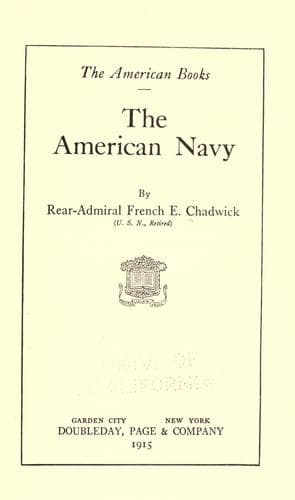
United States -- History, Naval; United States. Navy -- History
There can of course be no comparison between such forces; nor could
there in the long run be any doubt as to the result, but the American
navy was to achieve, in the unequal struggle, a series of victories
which brought results psychically the equal of victories of great
fleets. It is not that we were continuously victorious, but in the main
our success was so great and of a character to which the British navy
and public were so unaccustomed that our victories were a staggering
blow to Britain’s self-sufficiency. It must be remembered that the
French navy of Louis XVI’s time had been, so far as officers and morale
were concerned, swept out of existence by the French Revolution. The
French fleet of the Consular and Napoleonic period was now not only
ill-officered, but through the constant blockades of the British had
but little of the sea habit by which only a navy can be efficient. The
Spanish navy had no real organization or other qualities of success
under circumstances of even much worse neglect. The British ships,
well officered, well manned, and with constant sea practice, had no
real antagonists, for it is absurd to compare in efficiency such
organizations as that which fought under Nelson at Trafalgar and those
under Villeneuve and Gravina in the same battle. The American navy was
to show a different standard.
CHAPTER XV
There were three important and epoch-making events in the war: the
victory of the _Constitution_ over the _Guerrière_, the battle of Lake
Erie, and the battle of Lake Champlain. Each of these was of such
immense importance that they overshadow all others, picturesque and
striking as others were.
Public-domain text, read in full here on John Shaqi.
Reviews
Reviews
No reviews yet
Be the first to share your thoughts on this work.
Elsewhere in the archive
Join the Discussion
Join the discussion
Sign in to leave a comment or review.
Sign InorCreate an account