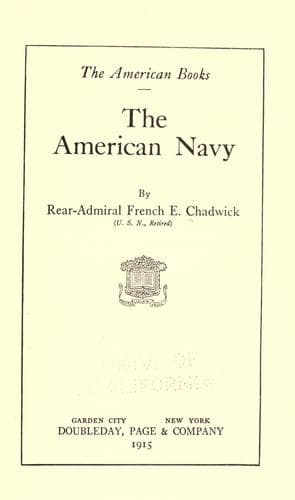
United States -- History, Naval; United States. Navy -- History
The war had now lasted six months, and instead of the little American
navy being swept from the sea, it had been a David to smite a Goliath.
The capture of three British frigates in the three successive combats
stirred Britain to the quick. Said the _Pilot_ of London: “Five hundred
merchantmen [taken] and three frigates! Can this be true? Will the
English people read this unmoved? Any man who foretold such disasters
this day last year would have been treated as a madman or a traitor. He
would have been told that ere seven months had gone the American flag
would have been swept from the ocean, the American navy destroyed, and
the maritime arsenals of the United States reduced to ashes. Yet not
one of the American frigates has struck. They leave their ports when
they choose, and return when it suits their convenience. They cross the
Atlantic, they visit the West Indies, they come to the chops of the
Channel, they parade along the coast of South America. Nothing chases
them; nothing intercepts them--nay, nothing engages them but to yield
in triumph.”[33]
CHAPTER XVI
The British force on our own coast was now, in 1813, much increased.
Particular attention was paid to the approaches of New York and to the
Chesapeake, which latter region was devastated. Destruction was carried
on under the general orders of the British Admiralty to “destroy and
lay waste all towns and districts of the United States found accessive
to the attacks of the British armaments.” Hampton, in Virginia, was
thus sacked with a brutality which even the very prejudiced British
historian, James, called “revolting to human nature.”
On February 24th the _Hornet_, which we left taking leave of the
_Montagu_, 74, at Bahia, was on January 24th off Demarara. A brig, the
_Espiegle_, was inside the bar; another, standing in for the port, was
the _Peacock_. She was ready to engage, and at 5:25 P.M. action opened;
fourteen minutes later the _Peacock_ was a prize and sinking. The two
vessels were equal in size and nearly equal in men, the _Hornet_ having
aboard 135 to the _Peacock’s_ 122. The _Hornet_ was superior in so far
as carrying 32-pound carronades to the _Peacock’s_ 24’s; but weight
of shot made no difference for the _Peacock’s_ guns did scarcely any
damage. Lawrence, overcrowded with prisoners, returned to the United
States, anchoring at Holmes Hole on March 19th. Less than three months
later he was to die a defeated man, aboard the _Chesapeake_, the victim
of rashness and over-confidence.
Public-domain text, read in full here on John Shaqi.
Reviews
Reviews
No reviews yet
Be the first to share your thoughts on this work.
Elsewhere in the archive
Join the Discussion
Join the discussion
Sign in to leave a comment or review.
Sign InorCreate an account