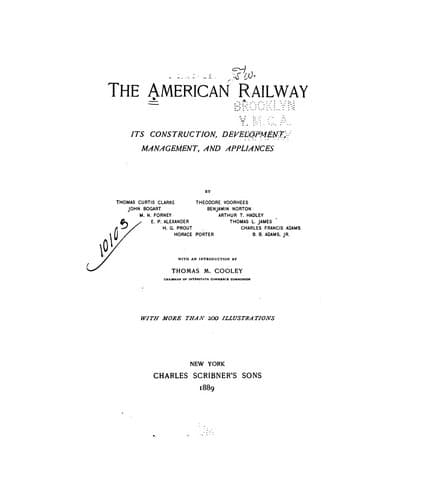
The American Railway: Its Construction, Development, Management, and AppliancesClarke, Thomas Curtis
History
The American Railway: Its Construction, Development, Management, and Appliances
Clarke, Thomas Curtis
Railroads -- United States
As the roads have found it necessary to act together in
establishing running rules and regulations, so, in spite of
all rivalries, there must also be joint agreements reached in
some way concerning rates. Usually the roads serving a certain
territory form an "association," and their freight agents form
"rate committees," which fix and publish joint rates. A tariff
published by one of the trunk lines from the Eastern cities forms a
good example. As the result of many long and bitter wars and many
compromises, it has been agreed among these roads that the rates
from New York to Chicago shall form a basis for all other rates,
and a scale has been fixed showing the percentage of the Chicago
rate to be used as the rate to each important point in the West.
Thus Pittsburgh, Pa., is 60 per cent. of Chicago rate; Indianapolis
is 93; Vandalia, 116. The tariff above referred to gives an
alphabetical list of some 5,000 towns reached over these roads, and
opposite each town the figure showing its percentage of the Chicago
rate. The list begins with Abanaka, O., 90, and ends with Zoar, O.,
74.
The tariff next gives what is called the "Trunk Line
Classification," which is a list comprising every article known to
commerce, in all the different conditions, shapes, and packages in
which it is offered for transportation, and opposite each article
is given its assigned "class." This particular classification
assigns every article to one of six regular, or two special,
classes, and the present rates to Chicago in cents per 100 lbs.
are given as 75, 65, 50, 35, 30, 25, 26, 21. The list of articles
begins with Acetate of Lime, in car-loads, 5th class; in less
quantities, 4th; and ends with Zinc, in various forms from 1st to
6th--comprising in all nearly 6,000 articles. From these tables any
desired rate readily appears. Thus, 500 pounds of acetate of lime
would cost, from New York to Zoar, O., 74 per cent. of Chicago's
4th class rate, or 74 per cent. of 35--say, 26 cents per 100 lbs.,
or $1.30.
There is also given in the tariff pamphlet a list of some 300
manufacturing towns in New England, from each of which the same
rates apply as from New York. So, on the whole, the pamphlet gives
rates on about 6,000 articles from 300 points of origin to 5,000
destinations.
In different sections of the country different classifications are
in use, some of them embracing twenty or more classes, and allowing
finer shades of difference between articles according to their
value, bulk, or many other varying conditions which determine the
class into which each article is put.
Great efforts have been made to bring about a uniformity of
classification over the whole United States, and the number of
classifications in extensive use has been reduced from a very large
number to perhaps a dozen.
Public-domain text, read in full here on John Shaqi.
Reviews
Reviews
No reviews yet
Be the first to share your thoughts on this work.
Elsewhere in the archive
Join the Discussion
Join the discussion
Sign in to leave a comment or review.
Sign InorCreate an account