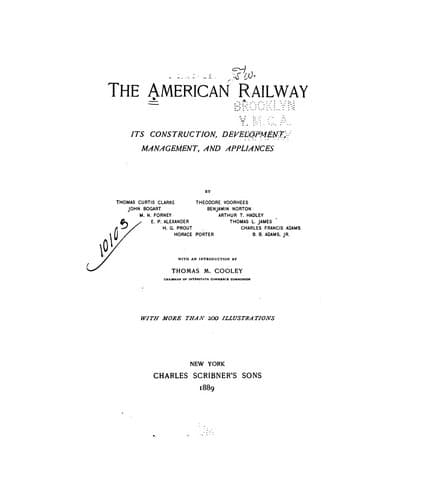
The American Railway: Its Construction, Development, Management, and AppliancesClarke, Thomas Curtis
History
The American Railway: Its Construction, Development, Management, and Appliances
Clarke, Thomas Curtis
Railroads -- United States
This fact must be borne in mind, for it is on this principle that
the automatic action of the brakes depends. If a train parts, or
if the air leaks out of the train-pipe, the brakes go on. This
automatic principle is a vital one in most safety appliances,
and it is secured in the case of the air-brake by one of the
most ingenious little devices that man ever contrived, that is,
the triple valve, which is placed in the piping system between
the brake-cylinder and the car-reservoir. This triple valve has
passages to the brake-cylinder, to the car-reservoir, to the
train-pipe, and to the atmosphere. Which of these passages are
open and which are closed depends upon the position of a piston
inside of the triple valve, and the position of that piston is
determined by the difference in air-pressure on either side of it.
Thus, when the pressure in the train-pipe is greater than that in
the car-reservoir, the triple valve piston is forced over, say to
the left, a communication is opened from the train-pipe to the
car-reservoir, and the air pressure in the latter is restored from
the main reservoir on the locomotive. At the same time a passage is
opened from the brake-cylinder to the atmosphere, the compressed
air escapes, the brake-piston is driven back by a spring, and
the brakes are released. If the pressure in the train-pipe is
reduced, the triple-valve piston is driven to the right (we will
assume) by the pressure from the car-reservoir, the passage to the
atmosphere is closed, air flows freely from the car-reservoir to
the brake-cylinder, and the brakes are applied.
The function of the engineer's valve is to control these
operations. Naturally the runner's left hand rests on this
instrument, which is fixed to the back head of the boiler. To apply
the brakes he turns the handle to such a position as to allow air
to escape from the train-pipe; to release, he turns it to allow air
to pass from the main or locomotive reservoir into the train-pipe,
and thence into the car-reservoir. It is hardly necessary to say
that the operation of the brake, which has been described for one
car, is practically simultaneous throughout the train. The brakes
on the driving-wheels of the engine are also automatically applied
at the same time as those of the cars and the tender.
Public-domain text, read in full here on John Shaqi.
Reviews
Reviews
No reviews yet
Be the first to share your thoughts on this work.
Elsewhere in the archive
Join the Discussion
Join the discussion
Sign in to leave a comment or review.
Sign InorCreate an account