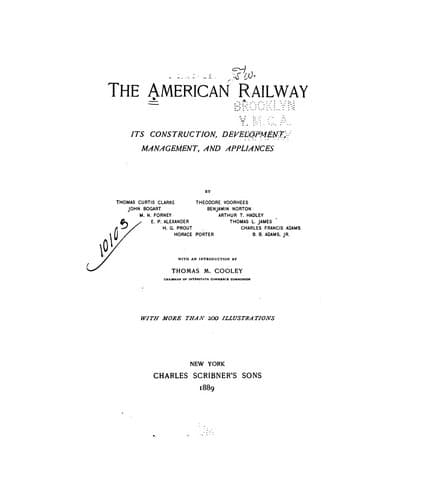
The American Railway: Its Construction, Development, Management, and AppliancesClarke, Thomas Curtis
History
The American Railway: Its Construction, Development, Management, and Appliances
Clarke, Thomas Curtis
Railroads -- United States
It would be an interesting study, were there space, to follow
the possible and proper combinations of movements to pass trains
over the various tracks. It will be seen that, by concentrating
the levers which move switches and signals in one place and
interlocking them, it is made mechanically impossible for a
signalman to give a signal which would lead to a collision or a
derailment within the region under his control. The only danger
at such points is that an engineer may overrun the signals. This
description of the objects and the capacity of the system of
interlocking is no fancy sketch. The system has been in use for
many years, doing just what has been here described, and more. A
recent close estimate gave the number of interlocked levers now in
use in the United States as about eight thousand, and the number
is rapidly increasing. Recent official reports showed that in
Great Britain and Ireland there were thirty-eight thousand cases
in which a passenger line was connected with or crossed by another
line, siding, or cross-over. In eighty-nine per cent. of these
cases the levers operating the switches and protecting signals were
interlocked.
The example of interlocking which has been given is one of the
simplest; the principle is capable of almost indefinite expansion,
and any one lever may be made to lock any one or more levers among
hundreds in the same frame. The greatest number of levers assembled
in any one signal-tower in this country is one hundred and sixteen,
at the Grand Central Station in New York. In the London Bridge
tower there are two hundred and eighty levers. This is probably the
greatest number in any one tower in the world. All of these levers
may be more or less interlocked. The same principle is applied to
the locking of two levers at a single switch, and to the protection
of drawbridges and highway crossings.
The mechanism by which the interlocking is done is strong and
comparatively simple, but a detailed description of it seems out
of place here. Two levers from a Saxby & Farmer machine are shown
on page 204, with lever _A_ normal and _B_ reversed. The locking
mechanism is in front of the levers, and is actuated not by the
levers themselves, but by their catch-rods. It follows that it is
not the actual movement of a signal which prevents the movement of
other signals, or of switches, but it is the intention to move that
signal. This principle of "preliminary locking" is one of great
importance.
Public-domain text, read in full here on John Shaqi.
Reviews
Reviews
No reviews yet
Be the first to share your thoughts on this work.
Elsewhere in the archive
Join the Discussion
Join the discussion
Sign in to leave a comment or review.
Sign InorCreate an account