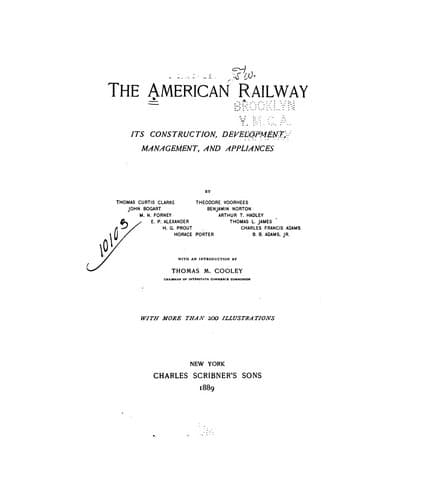
The American Railway: Its Construction, Development, Management, and AppliancesClarke, Thomas Curtis
History
The American Railway: Its Construction, Development, Management, and Appliances
Clarke, Thomas Curtis
Railroads -- United States
The Earliest Railway Passenger Advertisement--The First
Time-table Published in America--The Mohawk and Hudson
Train--Survival of Stage-coach Terms in English Railway
Nomenclature--Simon Cameron's Rash Prediction--Discomforts
of Early Cars--Introduction of Air-brakes, Patent Buffers
and Couplers, the Bell-cord, and Interlocking Switches--The
First Sleeping-cars--Mr. Pullman's Experiments--The
"Pioneer"--Introduction of Parlor and Drawing-room
Cars--The Demand for Dining-cars--Ingenious Devices for
Heating Cars--Origin of Vestibule-cars--An Important Safety
Appliance--The Luxuries of a Limited Express--Fast Time in
America and England--Sleeping-cars for Immigrants--The Village
of Pullman--The Largest Car-works in the World--Baggage-checks
and Coupon Tickets--Conveniences in a Modern Depot--Statistics
in Regard to Accidents--Proportion of Passengers in Various
Classes--Comparison of Rates in the Leading Countries of the
World.
From the time when Puck was supposed to utter his boast to put a
girdle round about the earth in forty minutes to the time when
Jules Verne's itinerant hero accomplished the task in twice that
number of days, the restless ingenuity and energy of man have
been unceasingly taxed to increase the speed, comfort, and safety
of passenger travel. The first railway on which passengers were
carried was the "Stockton & Darlington," of England, the distance
being 12 miles. It was opened September 27, 1825, with a freight
train, or, as it is called in England, a "goods" train, but which
also carried a number of excursionists. An engine which was the
result of many years of labor and experiment on the part of
George Stephenson was used on this train. Stephenson mounted it
and acted as driver; his bump of caution was evidently largely
developed, for, to guard against accidents from the recklessness of
the speed, he arranged to have a signalman on horse-back ride in
advance of the engine to warn the luckless trespasser of the fate
which awaited him if he should get in the way of a train moving
with such a startling velocity. The next month, October, it was
decided that it would be worth while to attempt the carrying of
passengers, and a daily "coach," modelled after the stage-coach
and called the "Experiment," was put on, Monday, October 10, 1825,
which carried six passengers inside and from fifteen to twenty
outside. The engine with its light load made the trip in about two
hours. The fare from Stockton to Darlington was one shilling, and
each passenger was allowed fourteen pounds of baggage. The limited
amount of baggage will appear to the ladies of the present day as
niggardly in the extreme, but they must recollect that the bandbox
was then the popular form of portmanteau for women, the Saratoga
trunk had not been invented, and the muscular baggage-smasher of
modern times had not yet set out upon his career of destruction.
The advertisement which was published in the newspapers of the day
Public-domain text, read in full here on John Shaqi.
Reviews
Reviews
No reviews yet
Be the first to share your thoughts on this work.
Elsewhere in the archive
Join the Discussion
Join the discussion
Sign in to leave a comment or review.
Sign InorCreate an account