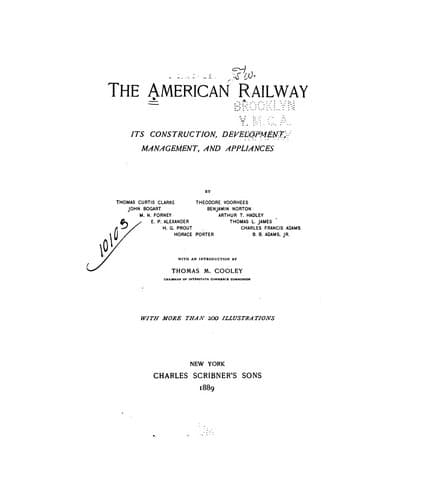
The American Railway: Its Construction, Development, Management, and AppliancesClarke, Thomas Curtis
History
The American Railway: Its Construction, Development, Management, and Appliances
Clarke, Thomas Curtis
Railroads -- United States
The speed of passenger trains has shown steady improvement from
year to year. In the month of June in our Centennial year, 1876,
a train ran from New York to San Francisco, a distance of 3,317
miles, in 83 hours and 27 minutes actual time, thus averaging
about 40 miles an hour, but during the trip it crossed four
mountain-summits, one of them over 8,000 feet high. This train ran
from Jersey City to Pittsburg over the Pennsylvania Railroad, a
distance of 444 miles, without making a stop. In 1882 locomotives
were introduced which made a speed of 70 miles per hour.
[Illustration: Pullman Sleeper on a Vestibuled Train.]
In July, 1885, an engine with a train of three cars made a trip
over the West Shore road which is the most extraordinary one on
record. It started from East Buffalo, N. Y., at 10.04 A.M., and
reached Weehawken, N. J., at 7.27 P.M. Deducting the time consumed
in stops, the actual running time was 7 hours and 23 minutes, or
an average of 56 miles per hour. Between Churchville and Genesee
Junction this train attained the unparalleled speed of 87 miles per
hour, and at several other parts of the line a speed of from 70 to
80 miles an hour. The superior physical characteristics of this
road were particularly favorable for the attainment of the speed
mentioned.
The trains referred to were special or experimental trains, and
while American railways have shown their ability to record the
highest speed yet known, they do not run their trains in regular
service as fast as those on the English railways. The meteor-like
names given to our fast trains are somewhat misleading. When one
reads of such trains as the "Lightning," the "Cannonball," the
"Thunderbolt," and the "G--whiz-z," the suggestiveness of the
titles is enough to make one's head swim, but, after all, the names
are not as significant of speed as the British "Flying Scotchman"
and the "Wild Irishman;" for the former do not attain an average
rate of 40 miles an hour, while the latter exceed 45 miles. A
few American trains, however, those between Jersey City and
Philadelphia, for instance, make an average speed of over 50 miles
per hour.
* * * * *
[Illustration: Immigrant Sleeping-car (Canadian Pacific Railway.)]
Public-domain text, read in full here on John Shaqi.
Reviews
Reviews
No reviews yet
Be the first to share your thoughts on this work.
Elsewhere in the archive
Join the Discussion
Join the discussion
Sign in to leave a comment or review.
Sign InorCreate an account