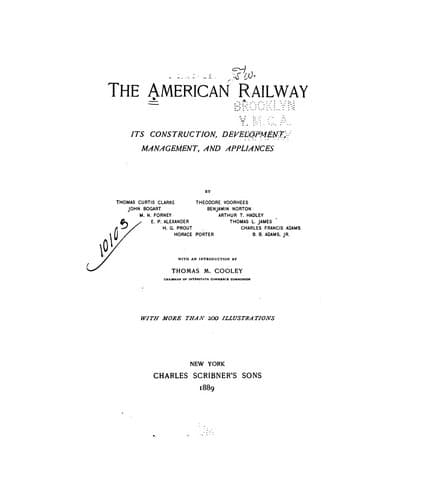
The American Railway: Its Construction, Development, Management, and AppliancesClarke, Thomas Curtis
History
The American Railway: Its Construction, Development, Management, and Appliances
Clarke, Thomas Curtis
Railroads -- United States
The earlier method, of allowing each passenger to pick out his own
baggage at his point of destination and carry it off, resulted in
a lack of accountability which led to much confusion, frequent
losses, and heavy claims upon the companies in consequence.
Necessity, as usual, gave birth to invention, and the difficulty
was at last solved by the introduction of the system known as
"checking." A metal disk bearing a number and designating on its
face the destination of the baggage was attached to each article
and a duplicate given to the owner, which answered as a receipt,
and upon the presentation and surrender of which the baggage could
be claimed. Railways soon united in arranging for through checks
which, when attached to baggage, would insure its being sent safely
to distant points over lines composed of many connecting roads. The
check system led to the introduction of another marked convenience
in the handling of baggage--the baggage express or transfer
company. One of its agents will now check trunks at the passenger's
own house and haul them to the train. Another agent will take up
the checks aboard the train as it is nearing its destination, and
see that the baggage is delivered at any given address.
The cases in which pieces go astray are astonishingly rare, and
some roads found the claims for lost articles reduced by five
thousand dollars the first year after adopting the check system,
not to mention the amount saved in the reduced force of employees
engaged in assorting and handling the baggage. Its workings are
so perfect and its conveniences so great that an American cannot
easily understand why it is not adopted in all countries; but he is
forced to recognize the fact that it seems destined to be confined
to his own land. The London railway managers, for instance, give
many reasons for turning their faces against its adoption. They say
that there are few losses arising from passengers taking baggage
that does not belong to them; that most of the passengers take a
cab at the end of their railway journey to reach their homes, and
it costs but little more to carry their trunk with them; that in
this way it gets home as soon as they, while the transfer company,
or baggage express, would not deliver it for an hour or two later;
that the cab system is a great convenience, and any change which
would diminish its patronage would gradually reduce the number of
cabs, and these "gondolas of London" would have to increase their
charges or go out of business. It is very easy to find a stick when
one wants to hit a dog, and the European railway officials seem
never to be at a loss for reasons in rejecting the check system.
Public-domain text, read in full here on John Shaqi.
Reviews
Reviews
No reviews yet
Be the first to share your thoughts on this work.
Elsewhere in the archive
Join the Discussion
Join the discussion
Sign in to leave a comment or review.
Sign InorCreate an account