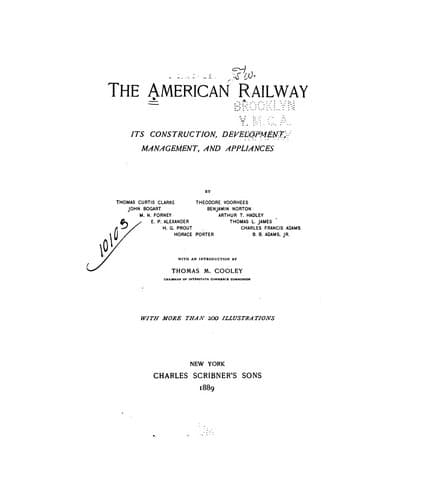
The American Railway: Its Construction, Development, Management, and AppliancesClarke, Thomas Curtis
History
The American Railway: Its Construction, Development, Management, and Appliances
Clarke, Thomas Curtis
Railroads -- United States
In addition to the conductors' train reports, the Car Accountant
receives reports from all junction stations daily, showing all cars
received from or delivered to connecting roads, whether loaded or
empty, and the destination of each. He also has reports from all
stations showing cars received and forwarded, from midnight to
midnight, cars remaining on hand loaded or empty; and if loaded,
contents and consignee, and also cars in process of loading or
unloading, and reports from shops or yards showing cars undergoing
repairs, or waiting for the same. In fine, he endeavors to get
complete reports showing every car that either may be in motion or
standing at any point on his road. All of these are entered on his
record books. The station reports check those of the conductor, and
_vice versa_. It will thus be seen that the record gives a complete
history of the movement and daily use of each car on the road.
In case of stock and perishable freight, or freight concerning
whose movements quick time is of the utmost importance, this
record is kept not only by days but by hours; that is, the actual
time of each movement is entered on the record. This is done by a
simple system of signs, so that an exact account of the movement,
giving date and hour of receipt and delivery, can be taken from the
record. This is frequently of the greatest value.
In addition to this, it is customary now for nearly all roads to
exchange what are known as "junction cards." They are reports from
one to another giving the numbers of all cars of each road passing
junction stations. These junction reports when received are also
carefully noted in the record, so that an account is kept in a
measure of the movement of home cars while on foreign roads, and
their daily location.
It would be difficult, and beyond the scope of this article, to
tell of the great variety of uses these records are put to. They
serve as a check upon reports of the mileage clerks, insuring their
accuracy. The junction reports serve also in a measure to check
the reports of foreign roads. Then, at frequent intervals, a clerk
will go over the record and note every car that is not shown to
have moved within, say, five days, putting down on a "detention
report" for each station the car number and date of its arrival.
These reports are sent to the agents for explanation, and then
submitted to the Superintendent. In a similar manner reports will
be made showing any use locally of foreign cars. From the record
can be shown almost at a glance the location of all idle cars,
information that is often very valuable, and that when wanted is
wanted promptly. Also, from the record, reports are constantly
being made out--"tracers," as they are termed--showing the location
and detention of home cars on foreign roads. In turn, foreign
tracers are taken to the record, and the questions therein asked
are readily answered by the Car Accountant.
Public-domain text, read in full here on John Shaqi.
Reviews
Reviews
No reviews yet
Be the first to share your thoughts on this work.
Elsewhere in the archive
Join the Discussion
Join the discussion
Sign in to leave a comment or review.
Sign InorCreate an account