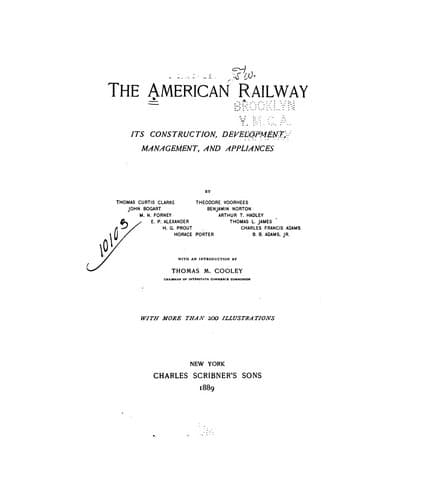
The American Railway: Its Construction, Development, Management, and AppliancesClarke, Thomas Curtis
History
The American Railway: Its Construction, Development, Management, and Appliances
Clarke, Thomas Curtis
Railroads -- United States
This has been the outgrowth of a single half-century. The vast
and intricate organization implied in the management of such an
interest had, as it were, to be improvised. The original companies
were small and simple affairs. Some retired man of business
held, as a rule, the position of president; while another man,
generally a civil engineer, and as such supposed to be more or
less acquainted with the practical working of railroads, acted as
superintendent. The superintendent, in point of fact, attended
to everything. He was the head of the commercial department; the
head of the operating department; the head of the construction
department; and the head of the mechanical department. But
there is a limit to what any single man can do; and so, as the
organization developed, it became necessary to relieve the railroad
superintendent of many of his duties. Accordingly, the working
management naturally subdivided itself into separate departments,
at the head of which men were placed who had been trained all their
lives to do the particular work required in each department. In
the same way, the employees of the company--the wage-earners, as
they are called--originally few in number, held toward the company
relations similar to those which the employees in factories, shops,
or on farms, held to those who employed them. In other words, there
was in the railroad system no organized service. As the employees
increased until they were numbered by hundreds, better organization
became a necessity. The community was absolutely dependent upon its
railroad service for continued existence, for the running of trains
is to the modern body politic very much what the circulation of
blood is to the human being. An organized system, therefore, had
to grow up. This fact was not recognized at first; and, indeed,
is only imperfectly recognized yet. Still the fact was there; and
inasmuch as it was there and was not recognized, trouble ensued.
No rationally organized railroad service--that is, no service in
which the employer and employed occupy definite relations toward
each other, recognized by each, and by the body politic--no such
service exists. Approaches to it only have been made. A discussion,
therefore, of the form that such a service would naturally take if
it were organized, cannot be otherwise than timely.
It has already been noticed that in the process of organization the
railroad, following the invariable law, naturally subdivides itself
into different departments.[32] In the case of every corporation of
magnitude there are of these departments, whether one man is at the
head of one or several of them, at least five. These are:
1st. The financial department, which provides the ways and means.
2d. The construction department, which builds the railroad after
the means to build it are provided.
3d. The operating department, which operates the road after it is
built.
Public-domain text, read in full here on John Shaqi.
Reviews
Reviews
No reviews yet
Be the first to share your thoughts on this work.
Elsewhere in the archive
Join the Discussion
Join the discussion
Sign in to leave a comment or review.
Sign InorCreate an account