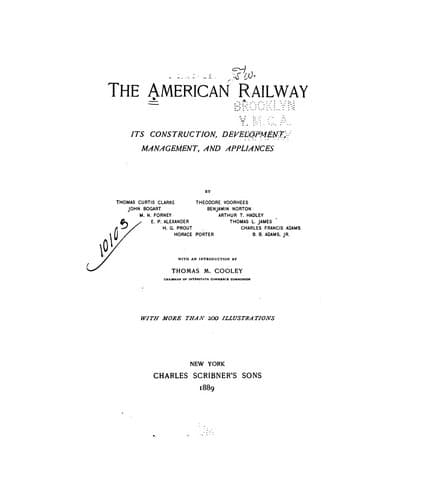
The American Railway: Its Construction, Development, Management, and AppliancesClarke, Thomas Curtis
History
The American Railway: Its Construction, Development, Management, and Appliances
Clarke, Thomas Curtis
Railroads -- United States
So far as the wage-earner is concerned, it is, therefore, this
portion of the force of a railroad company which may be called
distinctively "the service." If good relations exist between the
men employed in its operating department and the company no
serious trouble can ever arise in the operation of the road.
The clerks in the financial department, or the engineers in the
construction department, might leave the company's employ in a
body, and their places could soon be filled. In point of fact,
they never do leave it; but should they do so, the public would
experience no inconvenience. The inconvenience--and it would
be very considerable--would be confined to the office of the
company, and their work would fall into arrears. It is not so with
the operating department. So far as the community at large is
concerned, whatever difficulties arise in the working of railroads
develop themselves here. All serious railroad strikes take place
among those engaged in the shops, on the track, or in handling
trains. That these difficulties should be reduced to a minimum is
therefore a necessity. They can be reduced to a minimum only when
the railroad service is thoroughly organized.
How then can this service be better organized than it is? It is
usually maintained that only the ordinary relation of employer
and employed should exist between the railroad company and the
men engaged in operating its road. If the farmer is dissatisfied
with his hands, he can dismiss them. In like manner, if the
laborer is dissatisfied with the farmer, he can leave his employ.
It is argued that exactly the same relation should exist between
the great railroad corporation and the tens of thousands of men
in its operating department. The proposition is not tenable.
The circumstances are different. In the first place, it is of
no practical consequence to the community whether difficulties
which prevent the work of the farm from going on arise or do not
arise between an individual farmer and his laborers. The work of
innumerable other farms goes on all the same, and it is a matter
of indifference what occurs in the management of the particular
farm. So it is even with large factories, machine-shops--in fact,
with all industrial concerns which do not perform immediate
public functions. A railroad company does perform immediate
public functions. The community depends upon it for the daily
and necessary movements of civilized existence. This fact has to
be recognized. For a railroad to pause in its operation implies
paralysis to the community which it serves.
Such being the fact, it is futile to argue that the ordinary
relations of employer and employed should obtain in the railroad
service. Something else is required; and because something
else is required but has not yet been devised we have had the
numerous difficulties which have taken place during the present
year--difficulties which have occasioned the community much
inconvenience and loss.
Public-domain text, read in full here on John Shaqi.
Reviews
Reviews
No reviews yet
Be the first to share your thoughts on this work.
Elsewhere in the archive
Join the Discussion
Join the discussion
Sign in to leave a comment or review.
Sign InorCreate an account