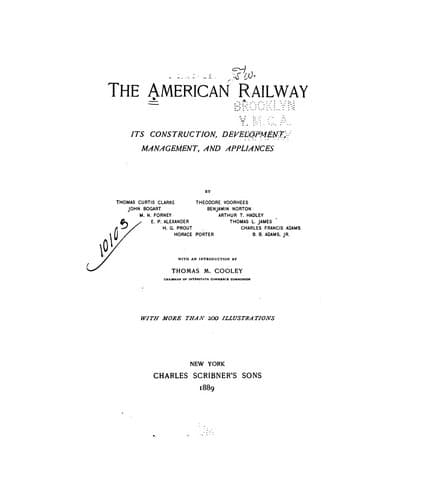
The American Railway: Its Construction, Development, Management, and AppliancesClarke, Thomas Curtis
History
The American Railway: Its Construction, Development, Management, and Appliances
Clarke, Thomas Curtis
Railroads -- United States
The Typical Railroad Man--On the Road and at Home--Raising the
Moral Standard--Characteristics of the Freight Brakeman--His Wit
the Result of Meditation--How Slang is Originated--Agreeable
Features of his Life in Fine Weather--Hardships in
Winter--The Perils of Hand-brakes--Broken Trains--Going back
to Flag--Coupling Accidents--At the Spring--Advantages of
a Passenger Brakeman--Trials of the Freight Conductor--The
Investigation of Accidents--Irregular Hours of Work--The
Locomotive Engineer the Hero of the Rail--His Rare Qualities--The
Value of Quick Judgment--Calm Fidelity a Necessary Trait--Saving
Fuel on a Freight Engine--Making Time on a Passenger
Engine--Remarkable Runs--The Spirit of Fraternity among
Engineers--Difficult Duties of a Passenger-train Conductor--Tact
in Dealing with Many People--Questions to be Answered--How
Rough Characters are Dealt with--Heavy Responsibilities--The
Work of a Station Agent--Flirtation by Telegraph--The
Baggage-master's Hard Task--Eternal Vigilance Necessary in a
Switch-tender--Section-men, Train Despatchers, Firemen, and
Clerks--Efforts to Make the Railroad Man's Life Easier.
The typical railroad man "runs on the road;" he is not the one
whose urbane presence adorns the much-heralded offices of the
railroad companies on Broadway, where the gold letters on the front
window are each considerably larger than the elbow-room allowed
the clerks inside; nor, indeed, is he, generally speaking, the one
with whom the public or the public's drayman comes in contact when
visiting a large city station to ship or receive freight. These and
others, whose part in the complex machinery of transportation is
in a degree auxiliary, are indeed largely imbued with the _esprit
de corps_ which originates in the main body of workers; but their
duties are such that their interest is not especially lively. Even
the men employed at stations in villages and large towns acquire
a share of their railroad spirit at second hand, as life on a
train is necessary to get the experience which embodies the true
fascination which so charms Young America.
The railroad man's home-life is not specially different from other
people's. There have been Chesterfields among conductors, and
mechanical geniuses have grown up among the locomotive engineers,
but these were products of an era now past. Station-men are a part
of the communities where their duties place them. Trainmen and
their families occupy a modest though highly respectable place in
the society they live in. Trainmen who live in a city generally
receive the same pay that is given to their brothers, doing the
same work, whose homes are in the country. The families of the
latter therefore enjoy purer air, lessened expenses, and other
advantages which are denied the former.
Public-domain text, read in full here on John Shaqi.
Reviews
Reviews
No reviews yet
Be the first to share your thoughts on this work.
Elsewhere in the archive
Join the Discussion
Join the discussion
Sign in to leave a comment or review.
Sign InorCreate an account