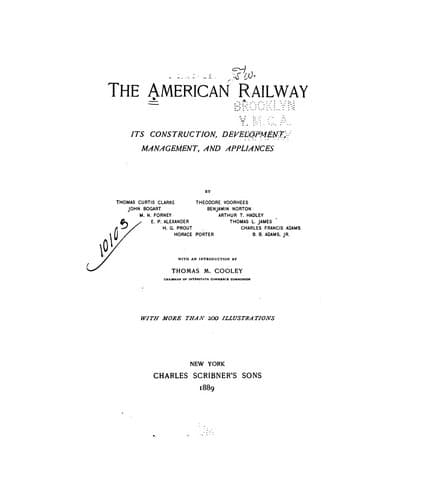
The American Railway: Its Construction, Development, Management, and AppliancesClarke, Thomas Curtis
History
The American Railway: Its Construction, Development, Management, and Appliances
Clarke, Thomas Curtis
Railroads -- United States
The brakeman must be on hand promptly at the hour of his train's
preparation for departure, and generally he must do his part in 15,
30, or 60 minutes' lively work in assembling cars from different
tracks, changing them from the front to the rear or middle of
the train, and setting aside those that are broken or disabled;
but, once on the road, by far the greater portion of his time is
his own, for his own enjoyment, almost as fully as that of the
passenger who travels for the express purpose of entertaining
himself. In mild weather and in daylight, life on the top of a
freight train is almost wholly devoid of unpleasant features, and
it takes on the nature of work only for the same reason that any
routine becomes more or less irksome after a time. Much of the time
there are a few bushels of cinders from the engine flying in the
air, which a novice can get into his eyes with great facility, but
the brakeman gets used to them. He sees every day (on many roads)
the beauties of nature in great variety. Much of the scenery of
the adjoining country is 500 per cent. more enjoyable from the
brakeman's perch on the roof than from the car windows, for the
reason that the increased height gives such an enlarged horizon.
This education from nature is an element in railroad men's lives
not to be despised. The trainman whose daily trips take him past
the panoramic charms of the Connecticut Valley in summer, through
the gorgeous-hued mountain-foliage along the Erie in autumn, or the
perennial grandeur of the Rocky Mountains in Colorado, certainly
enjoys a privilege for which many a city worker would gladly make
large sacrifices. But to trainmen the refining influence of these
surroundings is often an unconscious influence, and with the
majority of them is perhaps generally so, because of the prosaic
round of every-day thoughts filling their minds. There are also
some other advantages, not wholly unæsthetic, which a millionaire
might almost envy the freight trainman. Every twenty miles or so
the engine must stop for water, and it often happens that this
is in a cool place where the men can at the same time refresh
themselves with spring water whose sparkling purity is unknown in
New York or Chicago. Though brakemen who love beer are not by any
means scarce, an accessible spring or well of pure water along the
line always finds appreciative users during warm weather; and the
Kentuckian who sojourned six months in Illinois without thinking to
try the water there is not represented in the ranks of level-headed
brakemen. A certain railroad president regales himself in summer on
spring water brought in jugs from 100 miles up the road by trainmen
who find in this service an opportunity to "make themselves solid"
at headquarters. Freight trainmen get all the delicious products
of the soil at first hands. In their stops at way-stations they
get acquainted with the farmers, and can make their selection of
Public-domain text, read in full here on John Shaqi.
Reviews
Reviews
No reviews yet
Be the first to share your thoughts on this work.
Elsewhere in the archive
Join the Discussion
Join the discussion
Sign in to leave a comment or review.
Sign InorCreate an account