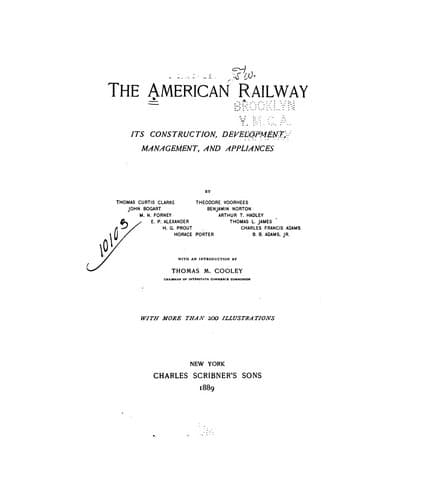
The American Railway: Its Construction, Development, Management, and AppliancesClarke, Thomas Curtis
History
The American Railway: Its Construction, Development, Management, and Appliances
Clarke, Thomas Curtis
Railroads -- United States
The freight conductor is simply a high grade of brakeman. His work
is almost wholly supervisory and clerical, and so, after several
years' service, he becomes more sober and business-like in his
bearing, the responsibilities of his position being sufficient
to effect this change; but he generally retains his sympathies
with his old associates who have become subordinates. His duties
are to keep the record of the train, the time, numbers of cars,
etc.; to see that the brakemen regulate the speed when necessary,
and to keep a general watch. The calculations necessary to make
a 75-mile trip and get over the line without wasting time are
often considerable, and an inexperienced conductor can easily
keep himself in a worry for the whole trip. Often he cannot go
more than ten miles after making way for a passenger train before
another overtakes him; so that he must spend a good share of his
time sitting in his caboose with the time-table in one hand and
his watch in the other, calculating where and when to side-track
the train. On single-track roads perplexities of this kind are
generally more numerous than on double lines, because trains both
in front and behind must be guarded against, and because the
regulations are frequently modified by telegraphic instructions
from headquarters. A mistake in reading these instructions,
which are written in pencil, often by a slovenly penman, and on
tissue-paper, may, and occasionally does, cause a disastrous
collision. These duties of conductors are especially characteristic
of trains that must keep out of the way of passenger trains, so
that in this particular line it will be seen that the passenger
conductor has much the easier berth. The freight and "work-train"
conductor must really be a better calculator, in many ways, than
the wearer of gilt badges and buttons, though the latter receives
the higher pay.
The _bête noire_ of the freight conductor is an investigation
at headquarters concerning delinquencies in which the blame is
divided. A typical case of this kind is that of a freight train
which has stopped at some unusual place and been run into by a
following train, doing some hundreds of dollars damage, if not
killing or injuring persons. "Strict adherence to rules will avert
all such accidents," the code says; but they do happen, and the
inquiry as to whether the conductor used due diligence in sending a
man with a red flag to warn the oncoming train, or the engineer of
the latter was heedless, or what was the trouble, is the occasion
of much anxiety.
Public-domain text, read in full here on John Shaqi.
Reviews
Reviews
No reviews yet
Be the first to share your thoughts on this work.
Elsewhere in the archive
Join the Discussion
Join the discussion
Sign in to leave a comment or review.
Sign InorCreate an account