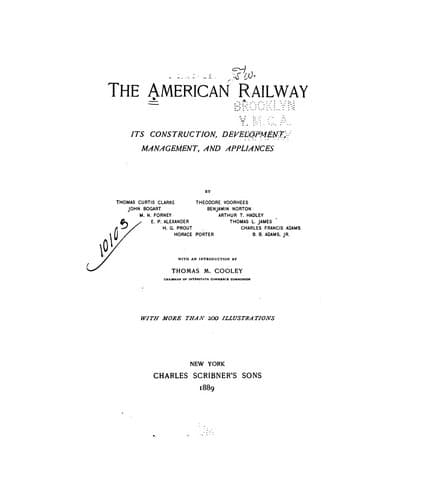
The American Railway: Its Construction, Development, Management, and AppliancesClarke, Thomas Curtis
History
The American Railway: Its Construction, Development, Management, and Appliances
Clarke, Thomas Curtis
Railroads -- United States
The locomotive engineer is the popular "hero of the rail," and the
popular estimate in this respect is substantially just. Others have
to brave dangers and perform duties under trying circumstances; but
the engine-runner has to ride in the most dangerous part of the
train, take charge of a steam-boiler that may explode and blow him
to atoms, and of machinery that may break and kill him, and try
to keep up a vigilance which only a being more than human could
successfully maintain. He must be a tolerably skilful machinist--he
cannot be too good--and have nerves that will remain steady under
the most trying circumstances. If running a fast express through
midnight darkness over a line where a similar train has been tipped
off a precipice (and a brother runner killed) by train-wreckers
the night before, he must dash forward with the same confidence
that he would feel in broad daylight on an open prairie. But he
does not "heroically grasp the throttle" in the face of danger,
when the throttle has been already shut, nor does he "whistle down
brakes," in order to add a stirring element to the reporter's tale,
when by the magic of the air-brake he can, with a turn of his hand,
apply every brake in the train with the grip of a vise in less time
than it would take him to reach the whistle-pull. When there is
danger ahead there is generally just one thing to do, and that is
to stop as soon as possible. An instant suffices for shutting off
the steam and applying the brake. With modern trains this is all
that is necessary or can be done. Reversing the engine is necessary
on many engines, and formerly was on all; this would, in fact, be
done instinctively by old runners, in any case, but this also is
done in a second. After taking these measures there is nothing
for the engineman to do but look out for his own safety. In some
circumstances, as in the case of a partially burned bridge which
may possibly support the train even in a weakened condition, it may
be best to put on all steam. The runner is then in a dilemma, and
a right decision is a matter of momentary inspiration. Many lives
have been saved by quick-witted runners in such cases, but there
is no ground for censure of the engineer who, in the excitement
of the moment, decides to slacken instead of quicken his speed.
The rare cases of this kind are what show the value of experience,
and of men of the right temperament and degree of intelligence to
acquire experience-lessons readily. The writer recalls an instance
several years ago where an alert, steady, and experienced runner
found himself on the crossing of another railroad with a heavy
train rushing toward him on the transverse track at uncontrollable
speed. It was too late to retreat, and in less than ten seconds the
oncoming train would crash broadside into his cars, filled with
passengers. A frantic effort to increase the speed and clear the
crossing would have either broken the weak couplings then in use or
Public-domain text, read in full here on John Shaqi.
Reviews
Reviews
No reviews yet
Be the first to share your thoughts on this work.
Elsewhere in the archive
Join the Discussion
Join the discussion
Sign in to leave a comment or review.
Sign InorCreate an account